How to Build Confidence in Public Speaking: 10 Steps That Work
How to build confidence in public speaking: 10 practical steps to prepare, calm your nerves, handle mistakes and speak often, plus a day-of checklist.
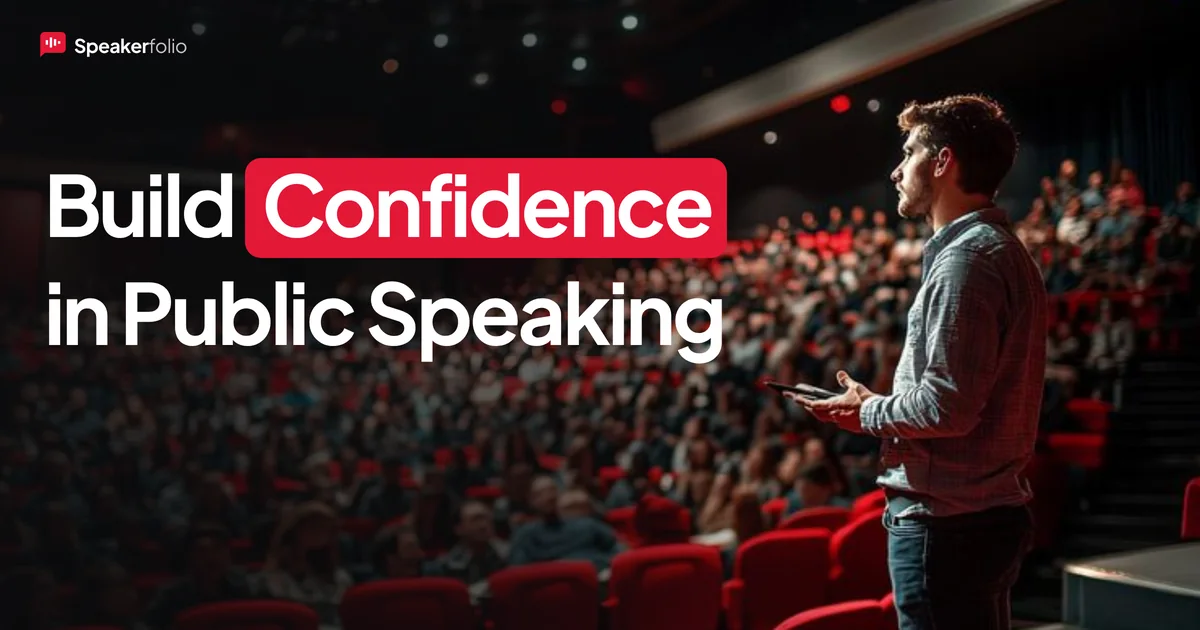
You build confidence in public speaking by preparing well, practising out loud, and speaking often enough that the stage starts to feel familiar. Nerves don't disappear for most speakers, even professionals. What changes is that you learn to expect them, calm your body, and trust your preparation. Start with small, low-pressure talks, record yourself, and work on one skill at a time. As your confidence grows, a speaker website and a profile in the Speakerfolio speaker directory help you turn it into real bookings.
Key takeaways
- Confidence comes from preparation and repetition, not from waiting until you stop feeling nervous.
- Practise out loud and on video, not just in your head.
- Calm your body first: slow breathing, a steady stance and a strong first minute make the rest easier.
- Speak often on small stages so big ones feel familiar.
Why public speaking feels scary
When you stand in front of a group, your body can react as if you are in danger. Your heart beats faster, your hands shake, your mouth goes dry and your mind races. That is your stress response at work. It is normal, and it happens to experienced speakers too.
Most fear of speaking comes from three worries:
- Being judged: "They'll think I don't know what I'm talking about."
- Forgetting: "My mind will go blank."
- Losing control: "My voice will shake and everyone will notice."
Each of these has a practical fix, and that's what the steps below are for.
How to build confidence in public speaking: 10 steps
Step 1: Know your material better than your script
Confidence starts with knowing what you want to say. Write down the one main message of your talk in a single sentence. Then list the three to five points that support it. If you know those points well, you can find your way back even if you lose your place.
Don't memorise every word. A memorised script breaks the moment you forget a line. Know your opening and closing by heart, and speak the middle from your key points.
Step 2: Practise out loud, not in your head
Reading your notes silently feels like practice, but it isn't. Say your talk out loud, standing up, at full volume. You'll find the sentences that are hard to say, the transitions that don't work and how long the talk really takes.
Aim to run through a full talk at least three to five times before an important event.
Step 3: Record yourself and watch it back
Set up your phone and record a practice run. Watching yourself is uncomfortable at first, but it shows you what the audience sees. Look for one or two things to improve each time, such as:
- Filler words like "um", "so" and "you know"
- Speaking too fast
- Looking at your slides instead of the audience
- Hands in your pockets or fidgeting
You'll usually find you look calmer on video than you felt.
Step 4: Rehearse in front of real people
Practise in front of a friend, a colleague or a small group. Ask them for one thing that worked and one thing to improve. Having faces in front of you is very different from talking to a wall, and it's the closest thing to the real event.
Step 5: Prepare a strong first minute
The first minute is when nerves are highest. Plan exactly how you'll start: a short story, a question or a surprising fact, followed by why the topic matters to this audience. When your opening goes well, your body starts to relax and the rest of the talk flows more easily.
Step 6: Calm your body before you speak
You can't think your way out of a racing heart, but you can breathe your way out of it. Before you go on stage, try slow breathing: breathe in through your nose for four counts, hold for four, breathe out for six. Repeat for a minute or two.
Other things that help:
- Drop your shoulders and unclench your jaw
- Stand with your feet hip-width apart and your weight even
- Drink water, and keep a glass nearby
- Walk around for a few minutes to use up nervous energy
Step 7: Call your nerves excitement
Nervousness and excitement feel almost the same in your body: fast heartbeat, energy, alertness. A 2014 study by Harvard Business School researcher Alison Wood Brooks found that people who told themselves "I am excited" before a speech were rated as more persuasive, competent and confident than people who tried to calm down.
Instead of telling yourself to relax, tell yourself you're excited to share something useful.
Step 8: Focus on the audience, not on yourself
Nerves grow when all your attention is on how you look and sound. Shift your attention to the people in front of you. Ask yourself: what do they need from this talk, and how can I help them?
During the talk, find a few friendly faces in different parts of the room and speak to them one at a time. It feels like a series of conversations instead of a performance.
Step 9: Plan for what could go wrong
Much of the fear is about what might happen. Decide in advance what you'll do if it does:
| If this happens | Do this |
|---|---|
| Your mind goes blank | Pause, take a breath, look at your notes or repeat your last point |
| Your voice shakes | Slow down, breathe from your belly and lower your pitch slightly |
| Your slides stop working | Keep going from your key points; your talk should work without slides |
| Someone asks a hard question | Thank them, answer what you can, and offer to follow up |
| You make a mistake | Correct it simply and move on; most people won't notice |
| The room feels quiet | Ask a simple question or invite a show of hands |
A pause feels long to you but natural to the audience. Use pauses on purpose and they become a sign of confidence.
Step 10: Speak often, starting small
Confidence comes from repetition. The more often you speak, the more familiar it feels. Look for low-pressure chances to practise:
- Team meetings and internal presentations
- Local meetups and community groups
- Toastmasters or another speaking club
- Webinars and online events
- Podcasts in your field
- Workshops for small groups
Each talk gives you evidence that you can do it, and that evidence is what confidence is made of. When you're ready to take it further, our guide on how to become a keynote speaker shows the next steps.
Quick fixes for common nervous signs
| Nervous sign | Quick fix |
|---|---|
| Shaking hands | Hold a clicker or rest your hands lightly on the lectern; use open gestures |
| Fast speech | Mark pauses in your notes and slow down on key points |
| Dry mouth | Sip water before you start and keep a glass on stage |
| Racing heart | Slow breathing for two minutes before you go on |
| Filler words | Replace "um" with a short pause |
| Looking at the floor | Pick three friendly faces in different parts of the room |
| Blank mind | Keep a one-page outline with your key points in large text |
Your day-of confidence checklist
- Arrive early and see the room before people arrive
- Test the microphone, slides and clicker
- Stand where you'll speak and look out at the seats
- Run through your opening line once, out loud
- Do two minutes of slow breathing
- Put water and your outline where you can reach them
- Smile at the first people who walk in
How confident speakers turn practice into bookings
Once you've built your confidence, the next challenge is getting invited to speak. Event planners look speakers up online before they book. They want to see your topics, a video of you speaking and what other organisers said about you.
Every talk you give is a chance to collect that proof. Ask organisers if you can record your session, then use the footage to make a short speaker reel. Ask for a testimonial after each event.
Speakerfolio helps you put all of this in one place. We write and build a free one-page speaker website from your LinkedIn profile, with your talks, video, testimonials and a booking form, on yourname.speakerfolio.com. You're also listed in the Speakerfolio speaker directory, where planners search for speakers. When you want your own domain and a custom design, Premium is $100 a year with hosting and updates included.
Frequently asked questions
How can I build confidence in public speaking fast?
Prepare one clear message, practise your talk out loud three to five times, record one run and watch it, and plan a strong opening. On the day, arrive early and do two minutes of slow breathing before you speak.
Is it normal to be nervous before speaking?
Yes. Most people feel nervous before speaking, including experienced professionals. The goal is not to remove nerves completely but to manage them so they don't get in your way.
How do I stop my voice from shaking when I speak?
Slow your breathing, breathe from your belly, speak a little slower and slightly lower, and pause between sentences. Sipping water beforehand also helps.
What should I do if I forget what to say?
Pause, take a breath and look at your notes or outline. You can also repeat your last point or ask the audience a question while you find your place. A short pause looks natural to the audience.
Should I memorise my speech?
Memorise your opening and closing, but not every word. Speak the middle from your key points so you can recover easily if you lose your place.
How long does it take to become a confident public speaker?
It depends on how often you speak. Most people notice a real difference after a handful of talks, especially if they record themselves and work on one skill at a time.
Does joining a speaking club help?
Yes. Clubs like Toastmasters give you regular, low-pressure chances to speak and get feedback, which is one of the fastest ways to build confidence.
Start building your confidence today
Confidence in public speaking is built one talk at a time. Prepare your message, practise out loud, calm your body and speak as often as you can. When you're ready to get booked, get your free speaker website from Speakerfolio so planners can find you.

Saleh is a UI/UX and web designer with more than five years of experience and the founder of Speakerfolio, where he builds websites that help speakers get booked. He specialises in conversion-focused design and on-page SEO.
Connect on LinkedInRelated articles
All articles