What Is a Keynote Speaker? How to Become a Keynote Speaker in 9 Steps
What is a keynote speaker, what do they do and how do you become one? A 9-step guide to your signature talk, first stages, fees and a speaker website.
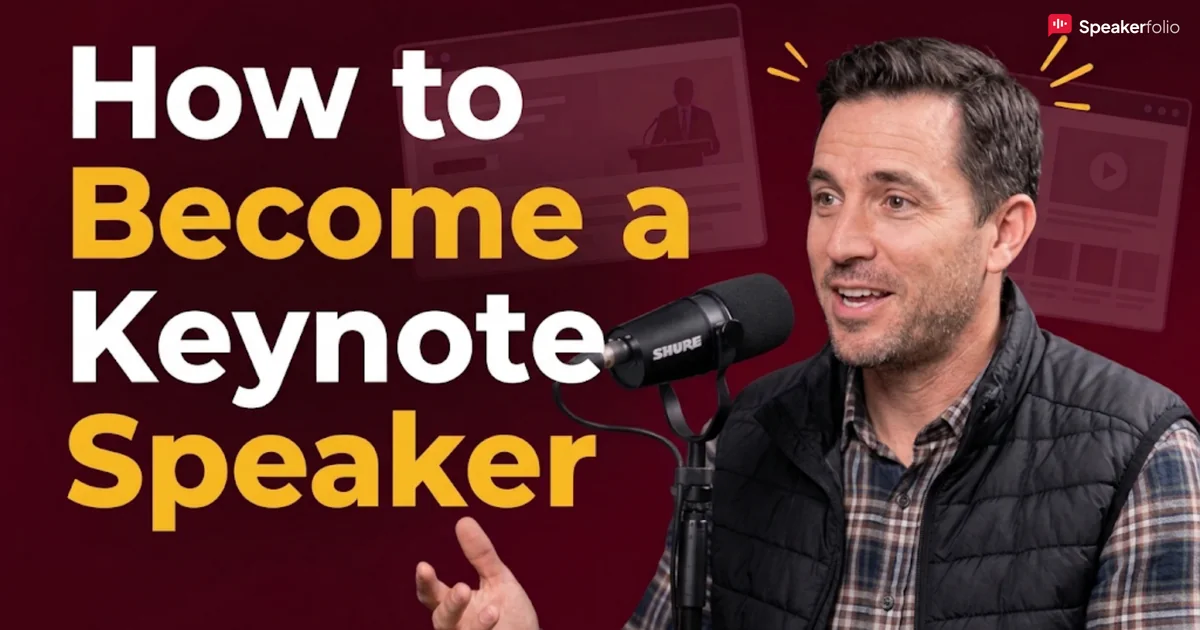
A keynote speaker is the person an event books to open or close it with a main talk that sets the theme for everyone in the room. Keynotes usually run 30 to 60 minutes, and they go to people with real expertise and a story worth hearing. To become a keynote speaker, pick one topic you know deeply, build a signature talk around it, practise on smaller stages, collect video and testimonials, and make yourself easy to find with a speaker website. Speakerfolio builds that website for you for free and lists you in its speaker directory, where planners search for speakers.
Key takeaways
- A keynote speaker delivers the main talk at an event and sets the tone for the rest of the programme.
- You don't need fame to start. You need one clear topic, one strong talk and proof that you can hold a room.
- Most speakers start small: free talks at meetups, associations and company events, then paid local keynotes.
- Planners check you online before they book, so a speaker website with your talks, video and a booking form matters early on.
What is a keynote speaker?
A keynote speaker gives the headline talk at a conference, company meeting, summit or awards night. The word comes from music, where the keynote is the note a piece is built around. A keynote talk does the same job for an event: it sets the theme that the other sessions follow.
Most keynotes are 30 to 60 minutes long and happen at the start of the event (the opening keynote) or at the end (the closing keynote). Some events also book a keynote for after lunch or dinner, when the room needs energy.
A keynote speaker is usually one of these:
- An expert in a field such as leadership, sales, health, technology or education
- A practitioner who has done something the audience wants to learn from, like building a company or leading a team through a crisis
- A storyteller with a personal experience that carries a lesson, such as an athlete, survivor or adventurer
- An author whose book gives the talk its framework
What does a keynote speaker do?
The talk is the visible part. Most of a keynote speaker's work happens before and after it.
Before the event, a keynote speaker talks to the organiser about the audience and goals, tailors examples and stories to that audience, prepares slides or visuals and checks the stage, sound and timing.
On the day, they deliver the talk, often answer questions, and sometimes stay for a book signing, a panel or a dinner with leaders.
After the event, they follow up with the organiser, share resources with attendees and ask for a testimonial.
Keynote speaker vs other types of speakers
| Speaker type | What they do | Typical length |
|---|---|---|
| Keynote speaker | Gives the main talk that sets the event's theme | 30 to 60 minutes |
| Breakout or session speaker | Leads a smaller session on one subtopic | 30 to 60 minutes |
| Workshop leader or trainer | Runs hands-on learning with exercises | Half day to full day |
| Panelist | Shares views in a moderated discussion with others | 45 to 60 minutes |
| Emcee or host | Introduces speakers and keeps the event on schedule | Whole event |
| Motivational speaker | Focuses on inspiration and mindset, often as a keynote | 30 to 60 minutes |
Many keynote speakers also offer workshops or virtual talks, which gives organisers more ways to book them.
Do you need to be famous to be a keynote speaker?
No. Celebrity speakers get the biggest fees, but most keynotes go to people who are known in one industry or on one topic. A regional sales director with a clear method for coaching teams can be the perfect keynote for a sales kick-off. A nurse who led a ward through a hospital merger can be the right keynote for a healthcare conference.
What planners look for is fit: the right topic for their audience, proof that you speak well, and confidence that you will be easy to work with.
How to become a keynote speaker: 9 steps
Step 1: Pick one topic you can own
Choose a topic where your experience is real and specific. "Leadership" is too wide. "How first-time managers keep their best people during change" is a topic a planner can picture on their agenda.
Ask yourself three questions:
- What do people already ask me for advice about?
- What have I done or lived through that others want to learn from?
- Which audiences need this, and do they hold events?
Step 2: Know your audience
Write down who your talk is for: their job, industry, seniority and the problem they face. The narrower the audience, the easier it is for planners in that space to say yes. You can widen it later.
Step 3: Build a signature talk
Your signature talk is the one you will give again and again, adapted for each event. A simple structure works:
- Opening: a story or moment that pulls the audience in
- The problem: what your audience struggles with and why it matters
- Your idea: a framework, method or lesson, usually in three to five parts
- Stories and proof: examples, results and moments from your own experience
- Close: what the audience should think, feel or do next
Give the talk a clear title and promise, such as "Lead Through Change: How Managers Keep Teams Focused When Everything Moves".
Step 4: Practise on smaller stages
Every keynote speaker starts somewhere small. Good first stages include:
- Industry meetups and networking groups
- Professional associations and chambers of commerce
- Your own company's team meetings and offsites
- Webinars and online summits
- Podcasts in your field
- Universities and alumni events
Speak for free at first if it gets you in front of the right audience. Ask every organiser if you can record the talk.
Step 5: Record your talks and make a speaker reel
Video is often the first thing a planner wants to see. Record every talk you can, even on a phone at the back of the room. Then cut your best moments into a two-to-three-minute speaker reel. Our guide to making a speaker reel shows how to do it from footage you already have.
Step 6: Collect testimonials
After each talk, ask the organiser for two or three sentences about what changed for their audience. A quote with a name, job title and organisation carries much more weight than an anonymous one. Collect attendee feedback too.
Step 7: Write your speaker bio and one-sheet
Planners need a short bio they can print in the programme and read out before you walk on stage. Write a 50-word and a 150-word version that say who you are, what you speak about and why you are credible. Then put your bio, talk titles, photo and contact details on a one-page speaker sheet. Our guide to writing a speaker bio walks through it.
Step 8: Get a speaker website
When a planner hears your name, they search for you. They also ask AI assistants like ChatGPT for speakers on their topic. If all they find is a social profile, it is hard for them to judge you and easy to move on to someone else.
A speaker website brings everything together in one place:
- Your topic and who you help
- Your signature talks and what audiences take away
- Your speaker reel
- Testimonials from organisers
- Past events and logos
- Your bio and photos
- A booking form
A clear website also helps Google and AI assistants understand who you are and what you speak about. It cannot guarantee a ranking or a recommendation, but it makes both far more likely than a social profile alone.
Step 9: Start pitching and set your fees
With a talk, video, testimonials and a website, you can start contacting event organisers. Look for events your audience attends, find the person who books speakers and send a short, specific pitch with a link to your website.
As you gain experience, start charging. Fees vary a lot by experience and industry. Many speakers start with local and nonprofit events and raise their fees as demand grows.
| Speaker level | Typical fee per keynote |
|---|---|
| New speaker | Free to $1,500 |
| Emerging speaker | $1,500 to $5,000 |
| Established professional | $5,000 to $30,000 |
| Celebrity or bestselling author | $30,000 to $100,000+ |
Skills every keynote speaker needs
- Storytelling: turning experience into stories with a clear point
- Stage presence: voice, pace, movement and eye contact
- Audience awareness: reading the room and adjusting as you go
- Tailoring: adapting one talk to different industries and goals
- Reliability: being on time, prepared and easy to work with
- Self-promotion: sharing your work so the right people know you exist
You can improve all of them. Groups like Toastmasters, speaking coaches and watching your own recordings all help.
Common mistakes new keynote speakers make
- Choosing a topic so broad that no planner knows where to place them
- Writing a new talk for every event instead of refining one signature talk
- Not recording talks, then having no video when a planner asks
- Forgetting to ask for testimonials while the event is still fresh
- Relying only on LinkedIn or Instagram instead of having a proper speaker website
- Pitching events without a clear link that shows talks, video and how to book
How Speakerfolio helps new keynote speakers
Speakerfolio builds websites for speakers, trainers and coaches. You send your LinkedIn profile, and we write and build a one-page speaker website for you, with your talks, video, testimonials and a booking form. It goes live on yourname.speakerfolio.com, usually within two working days, and it costs nothing.
Every speaker also gets a profile in the Speakerfolio speaker directory, where event planners search for speakers by topic and format. Your free site includes a speaker one-sheet and basic AI visibility setup.
When you are ready for your own domain, a custom design, unlimited pages and full control, Premium is $100 a year with hosting and updates included. See Premium pricing for details, or read why we built a free website for keynote speakers.
Frequently asked questions
What is a keynote speaker?
A keynote speaker gives the main talk at an event, usually at the start or end. The keynote sets the theme for the event and typically lasts 30 to 60 minutes.
How do I become a keynote speaker with no experience?
Pick one topic you know well, build a signature talk, and practise at meetups, associations, webinars and company events. Record your talks, collect testimonials and create a speaker website so planners can find and book you.
How long does it take to become a keynote speaker?
It depends on your topic, network and how often you speak. Many people get their first paid keynote after giving a series of free or low-fee talks and building video and testimonials along the way.
How much do keynote speakers get paid?
New speakers often start free or under $1,500. Emerging speakers usually charge $1,500 to $5,000, established professionals $5,000 to $30,000, and celebrities $30,000 or more per keynote.
Do keynote speakers need a website?
Yes. Planners search speakers online before booking. A speaker website shows your talks, video, testimonials and booking form in one place, and it helps Google and AI assistants understand what you speak about.
What is the difference between a keynote speaker and a motivational speaker?
A keynote speaker is defined by their role at the event: giving the main talk. A motivational speaker is defined by their style: inspiring the audience. Many motivational speakers are booked as keynote speakers.
Can I be a keynote speaker part time?
Yes. Many keynote speakers have full-time careers and speak a few times a year. Their day job is often what makes them credible on their topic.
Start your keynote speaking career
Becoming a keynote speaker starts with one topic, one strong talk and the proof that you can deliver it. Practise on small stages, record everything, collect testimonials and give planners an easy way to find you.
Get your free speaker website built by Speakerfolio, or browse the speaker website templates first.

Saleh is a UI/UX and web designer with more than five years of experience and the founder of Speakerfolio, where he builds websites that help speakers get booked. He specialises in conversion-focused design and on-page SEO.
Connect on LinkedInRelated articles
All articles