How to Present Your Leadership Framework on One Page
How to present your leadership framework on one page: a full example, six framework shapes, a free template and how to show it on your speaker website.
To present your leadership framework on one page, give it a name, write a one-sentence promise, pick a shape that matches how the idea works (steps, cycle, pyramid, matrix, pillars or acronym), limit it to three to five parts, and give each part one line of meaning plus a question, an action and a result. Then add who it's for, where you deliver it and one piece of proof. Below is a complete one-page leadership framework example, the anatomy of each block, six shapes to choose from, a free template, and screenshots of how Speakerfolio's speaker website templates present a framework online.
Key takeaways
- One page forces clarity. If your leadership framework doesn't fit on a page, it won't fit in a manager's head either.
- Three to five parts is the sweet spot. More than that and people stop remembering.
- Every part needs an action. A framework people can use on Monday beats one they can only admire.
- Use it everywhere: your keynote, handouts, one-sheet, proposals and your speaker website.
Why your leadership framework belongs on one page
Most leadership speakers, coaches and trainers have a framework. It might be four steps for leading through change, five habits of trusted managers, or three levels of team performance. It's often the most valuable thing they own. It's what makes their keynote different from the next speaker's, what workshops are built on, and what clients remember months later.
But many frameworks live in a 40-slide deck, a book chapter or the speaker's head. When an event planner, HR director or attendee asks "so what's your approach?", the answer takes ten minutes.
A one-page leadership framework fixes that. It does three jobs:
| Who reads it | What they need | What one page gives them |
|---|---|---|
| Event planners and HR buyers | To understand your approach fast and explain it to their boss | A clear, shareable summary of what you teach |
| Attendees | Something to keep and use after the session | A handout they pin to the wall or save on their phone |
| You | A consistent way to explain your work | One version you use on stage, in proposals and online |
There's also a quieter benefit. Squeezing your framework onto one page shows you which parts matter. Anything that doesn't earn its space probably doesn't belong in the framework at all.
A one-page leadership framework example
Here's a complete example. Amara Okafor is the demo leadership trainer from Speakerfolio's Trainer template, and this is her framework for managers leading through change:
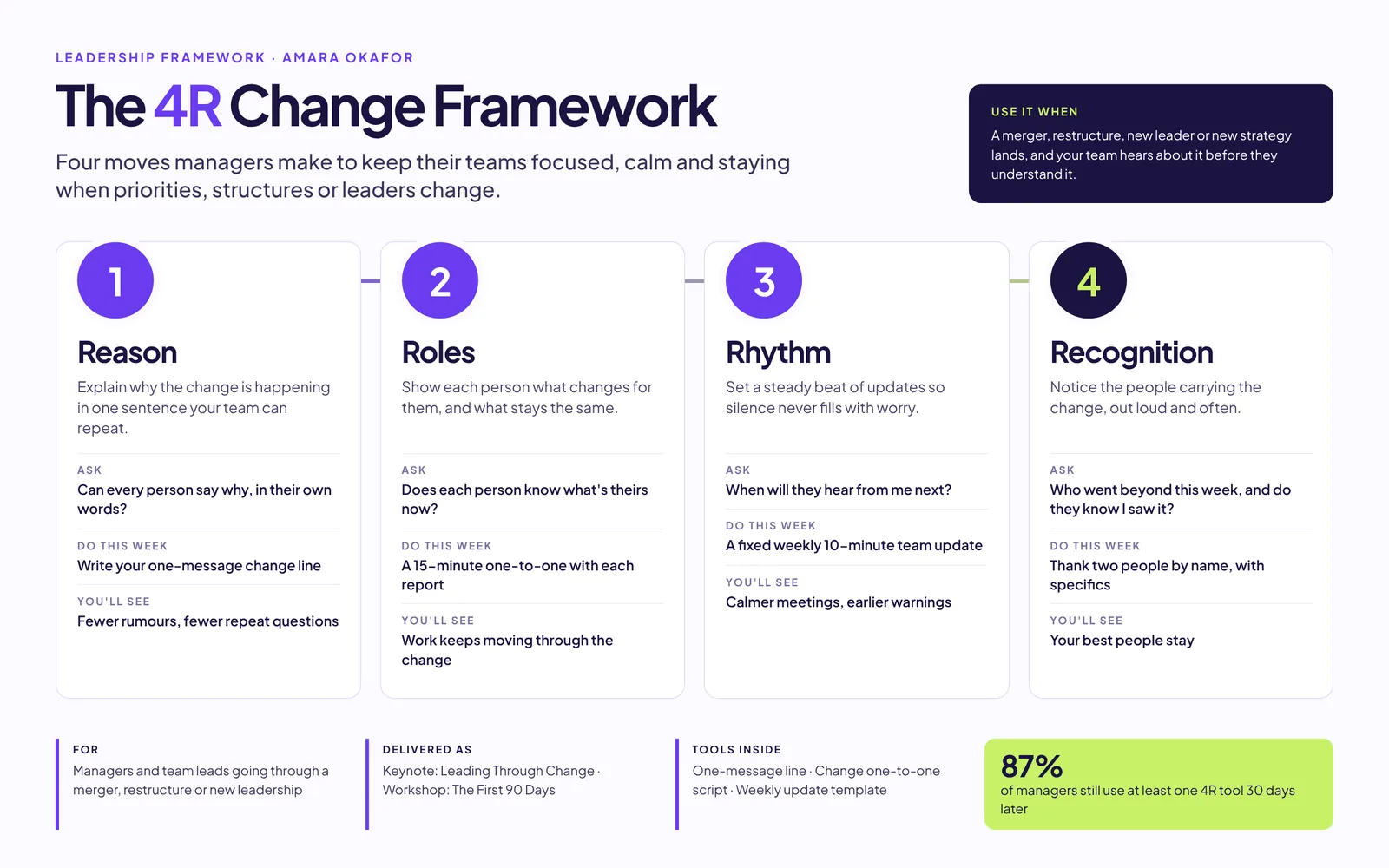
The 4R Change Framework on one landscape page. Click it to download the free PDF template.
In under a minute, a reader knows the framework's name, what it promises, when to use it, the four steps in order, what to ask, what to do and what to expect at each step, who it's for and how it's delivered. There's even proof that it works. That's everything an HR director needs to say "this is what we need for our managers."
The anatomy of a one-page leadership framework
Here's the same page with each block numbered. The rest of this guide explains how to build each one.
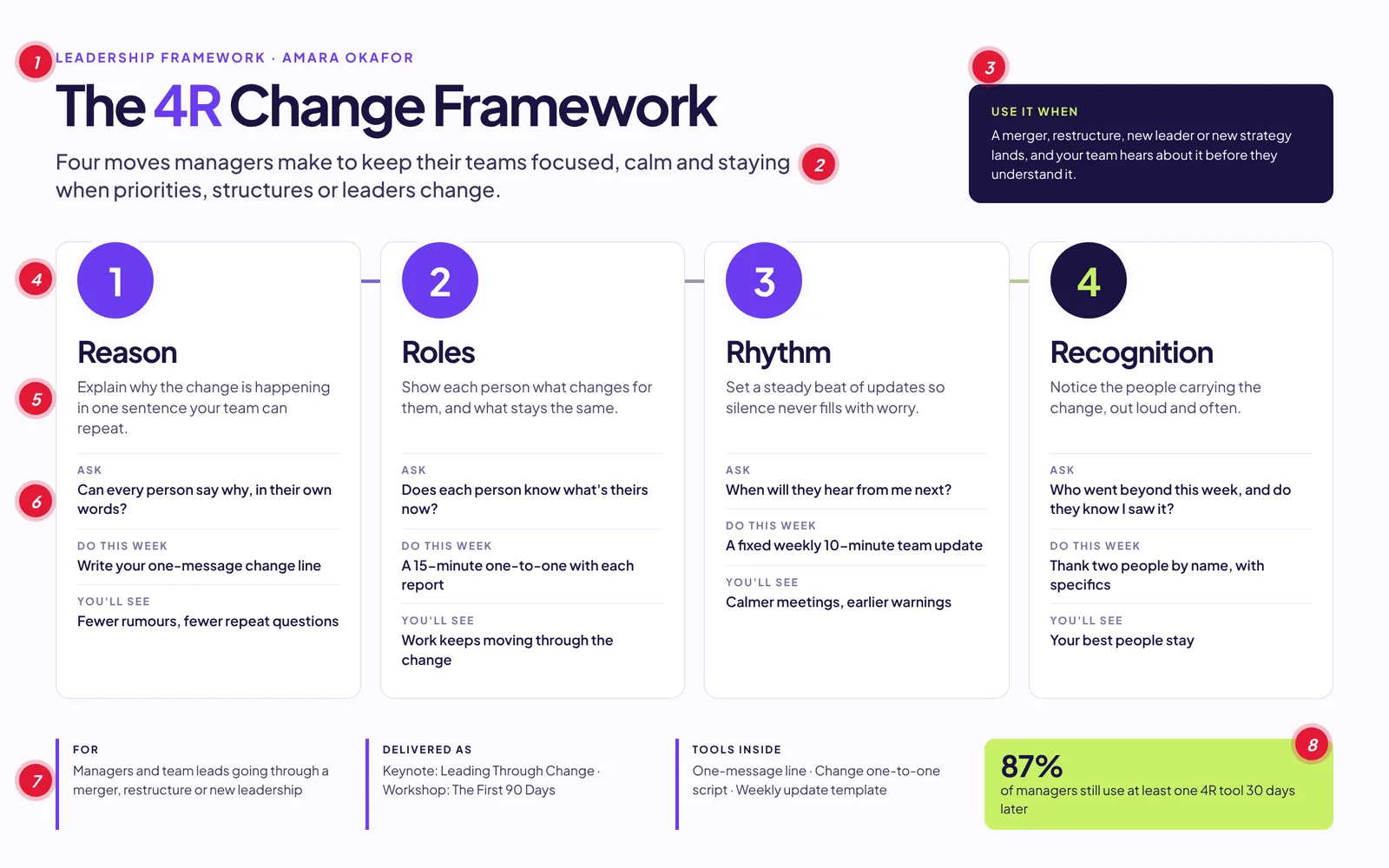
The eight blocks of a one-page leadership framework.
| # | Block | What it does |
|---|---|---|
| 1 | Name | Makes the framework easy to remember and refer to |
| 2 | Promise | Says what changes for the people who use it |
| 3 | When to use it | Tells readers the situation it's built for |
| 4 | Shape and steps | Shows how the parts relate: in order, in a loop, in levels |
| 5 | One-line meaning | Explains each part in plain words |
| 6 | Question, action, result | Turns each part into something people can do |
| 7 | Context | Who it's for, how it's delivered, what tools come with it |
| 8 | Proof | Shows that it works |
Step 1: Give your framework a name people can say
A name turns an idea into a thing. "My approach to change" is forgettable. "The 4R Change Framework" is something a manager can mention in a meeting, an HR director can put in a proposal and an attendee can search for later.
Good framework names usually follow one of a few patterns:
| Pattern | Example | Works well when |
|---|---|---|
| Number + letter or word | The 4R Change Framework | The parts share a first letter or theme |
| Acronym | The CLEAR model | People need to recall it without notes |
| Metaphor | The Leadership Compass | Your idea has a natural image |
| Method name | The Clarity Method | The framework is a process you take clients through |
| Plain description | The Three Conversations of Trust | You want it to be self-explanatory |
A few rules that save trouble later:
- Say it out loud. If it's awkward to say on stage, change it.
- Check that it's yours. Search the name with words like "leadership framework" or "model" before you commit. Plenty of acronyms are already taken.
- Don't force an acronym. If you have to use an obscure word to make the letters work, the acronym is costing you clarity. A plain name is better than a clever one that confuses people.
Step 2: Write a one-sentence promise
Under the name, write one sentence that says what the framework does and for whom. This is the line a planner reads first and repeats to their boss.
A useful structure is: who + what they do + what changes.
- "Four moves managers make to keep their teams focused, calm and staying when priorities, structures or leaders change."
- "Three conversations that help new leaders earn trust in their first 90 days."
- "Five habits that turn a group of experts into a team that makes decisions together."
Compare those with promises that say nothing: "A holistic approach to transformational leadership" or "Unlocking human potential." If a promise could sit on any coaching website, rewrite it until it could only be yours.
Add a "use it when" line next to the promise if your framework is built for a specific situation, like a merger, a first management role or a hybrid team. It helps the right readers recognise themselves straight away.
Step 3: Pick the shape that matches how your idea works
The shape of your framework tells the reader how the parts relate before they read a single word. Pick the one that matches how your idea actually works, not the one that looks most impressive.
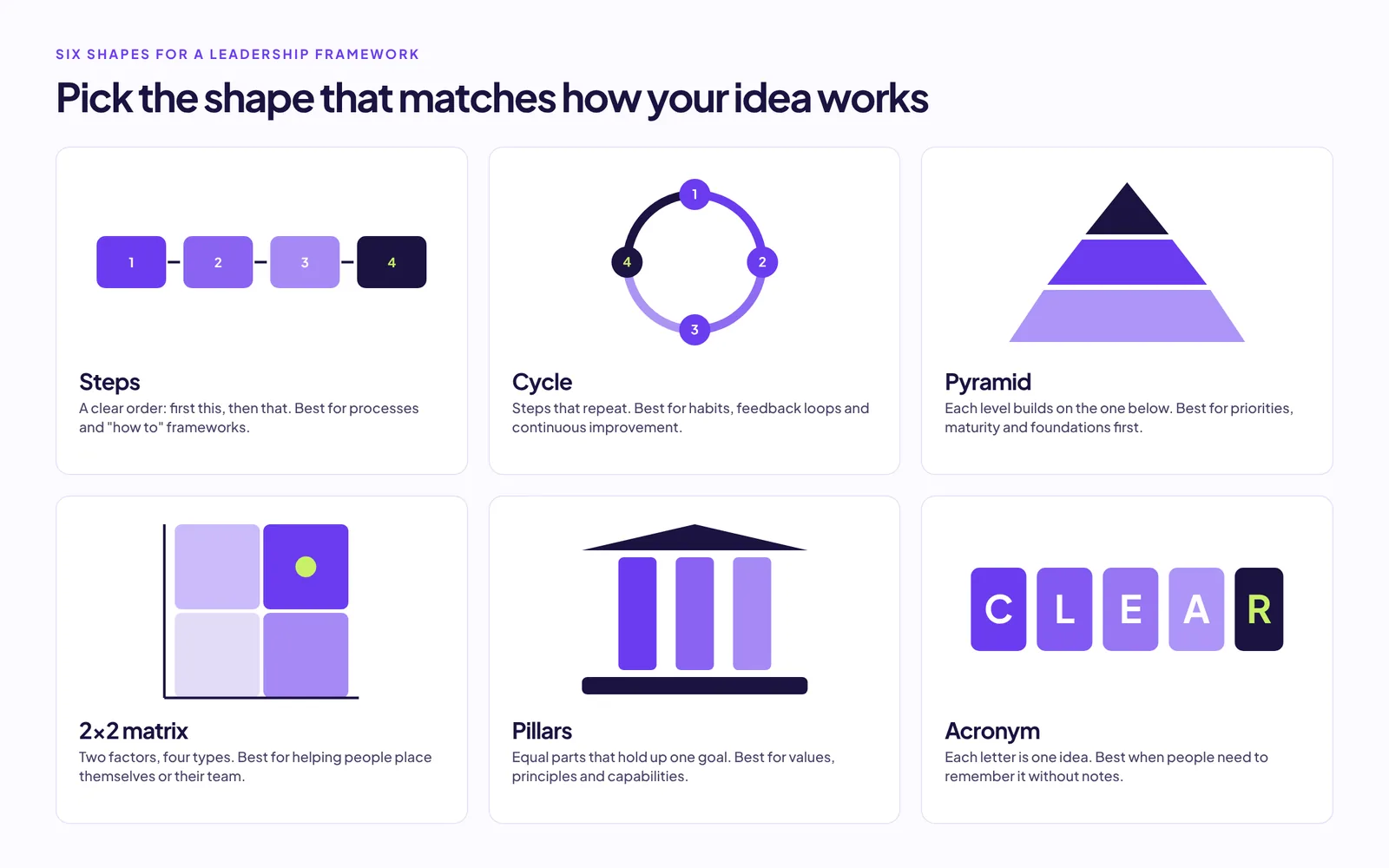
Six common shapes for a leadership framework, and what each one says about your idea.
| Shape | What it says | Use it for | Watch out for |
|---|---|---|---|
| Steps | Do these in order | Processes, "how to" frameworks, first 90 days | Implying order when there isn't one |
| Cycle | These repeat | Habits, feedback loops, continuous improvement | Cycles with no clear starting point |
| Pyramid | Each level builds on the one below | Priorities, maturity levels, foundations first | Suggesting the top matters more than the base |
| 2×2 matrix | Two factors create four types | Helping people place themselves or their team | Labels that feel like judgements |
| Pillars | Equal parts support one goal | Values, principles, capabilities | Pillars that overlap |
| Acronym | Each letter is one idea | Anything people must recall without notes | Forced letters and weak words |
The 4R framework in our example uses steps, because the order matters: managers need to explain the reason before they redefine roles, and set a rhythm before recognition feels natural. If the order didn't matter, pillars would be the more honest shape.
Two shapes can work together. An acronym can sit inside steps (each letter is a step), and a cycle can sit inside a pyramid level. Keep it to one main shape, though. A page with three diagrams is no longer a one-page framework.
Step 4: Keep it to three to five parts
Most strong leadership frameworks have three, four or five parts. That's not a strict rule, but there are good reasons for it:
- People remember short lists. Three to five items is roughly what most people can hold in mind and recall later without notes.
- Each part needs space. On one page, five parts already means tight writing.
- Fewer parts force decisions. If you have nine, some of them are probably the same idea, or details of a bigger idea.
If your framework has more than five parts, try grouping them. Seven behaviours might become three categories with two or three behaviours each, and the categories become the framework. The details can live in your workshop, your book or your website.
A quick test: for each part, ask "if I removed this, would the framework still work?" If the answer is yes, it's a detail, not a part.
Step 5: Explain each part in one line
Under each part's name, write one sentence that says what it means in plain language. No jargon, no buzzwords, no "leverage synergies."
| Vague | Clear |
|---|---|
| Reason: Purpose-driven communication | Reason: Explain why the change is happening in one sentence your team can repeat |
| Roles: Role clarity and alignment | Roles: Show each person what changes for them, and what stays the same |
| Rhythm: Cadence of engagement | Rhythm: Set a steady beat of updates so silence never fills with worry |
| Recognition: Appreciation culture | Recognition: Notice the people carrying the change, out loud and often |
Try reading the clear versions to someone who has never heard of the framework. They should understand each part without you explaining it. That's the standard, because on a handout or a website you won't be there to explain it.
Step 6: Turn each part into a question, an action and a result
This is the step that makes a framework useful rather than just interesting. For each part, add three short lines:
- Ask: a question the reader can ask themselves or their team
- Do this week: one specific action they can take straight away
- You'll see: what changes when they do it
In the 4R example, the "Rhythm" step reads:
- Ask: When will they hear from me next?
- Do this week: A fixed weekly 10-minute team update
- You'll see: Calmer meetings, earlier warnings
These three lines do a lot. The question makes the reader reflect. The action gives them something to do on Monday. The result tells them what success looks like, so they know whether it's working.
They also make your framework far more convincing to buyers. An HR director reading "do this week: a 15-minute one-to-one with each report" can picture their managers doing it. That's much easier to sell internally than a page of concepts.
You can use different labels to suit your style, such as "Reflect / Practise / Notice" or "Question / Tool / Outcome", but keep the same three-part structure for every step, so the page reads as one system.
Step 7: Add context: who, when and how it's delivered
A framework floating on a page can feel academic. A small context row at the bottom grounds it in the real world:
- For: who uses it (managers going through a merger, new team leads, executive teams)
- Delivered as: the keynote, workshop or program where you teach it
- Tools inside: worksheets, scripts or templates that come with it
This row quietly turns your framework into a sales tool. A planner who likes the framework immediately sees which talk or workshop to book. An attendee sees there's more to learn. Our guide on how to create a speaker one-sheet uses the same idea: every page you hand out should point to the next step.
Step 8: Add one piece of proof
End with a single number or quote that shows the framework works. In the example, it's "87% of managers still use at least one 4R tool 30 days later."
Good proof for a leadership framework includes:
- A follow-up survey result ("87% still using a tool after 30 days")
- A business outcome a client reported ("first-year manager turnover halved")
- A rating ("4.9/5 from 1,800+ participants")
- A short quote from a named client
Use only numbers you can back up. If you don't have proof yet, leave this block out and add it after your next program. Run a short follow-up survey 30 days after each session and you'll have real numbers within a few months.
Step 9: Design the page so it reads in 30 seconds
You don't need to be a designer. You need a few rules:
- Pick the orientation for where it will be used. Landscape (16:9 or 16:10) works for slides, screens and websites. Portrait (Letter or A4) works for printed handouts.
- Give the name and promise the top fifth of the page. They should be the first thing anyone reads.
- Make the shape the visual centre. Your steps, cycle or pyramid should take up most of the space.
- Use one main colour and one accent. Ideally your brand colours, the same as your website.
- Use one font family, in three sizes: title, part names, body text.
- Leave white space. Crowded pages look complicated, and a framework that looks complicated feels hard to use.
- Number the parts if order matters, even if your shape already shows it.
- Check it at small sizes. Shrink it to a phone screen. If you can still read the name and part names, it works.
Canva, Google Slides, PowerPoint, Keynote and Figma all work. If you build your talks in slides, design the one-page framework as a single slide. You can then use it in your deck and export it as a PDF handout.
Step 10: Test it before you use it
Before the page goes into a keynote or proposal, test it with two quick exercises:
- The 30-second test. Show the page to someone who doesn't know your work for 30 seconds, then take it away. Ask them to name the framework and as many parts as they can. If they can't name at least most of the parts, simplify.
- The teach-back test. Ask a manager to explain the framework to you in their own words using only the page. Where they hesitate or get it wrong is where your wording needs work.
Then ask one more question: "Which part would you try first?" If they can answer, your actions are working.
Where to use your one-page leadership framework
Once you have it, use it everywhere. Consistency is what turns a framework into something people associate with you.
| Where | How to use it |
|---|---|
| Your keynote | One slide that you return to throughout the talk, building it up part by part |
| Workshop handouts | Printed at A4 or Letter, with space for notes |
| Your speaker one-sheet | A simplified version in the talks section |
| Proposals | Page two, right after the client's goals, to show your approach |
| Your speaker website | A section that presents the framework visually (see below) |
| A post with the page as an image, or in your Featured section | |
| Follow-up emails | Attached after every session, so attendees keep using it |
| Your book or course | The visual summary at the start of each chapter or module |
If you speak on stage, build the framework slide by slide during the talk: show part one, explain it, then reveal part two. By the end, the audience has seen the full page come together, which helps them remember it. Our article on the secrets of great public speakers covers more ways to make ideas like this stick on stage.
How to show your leadership framework on your speaker website
Your website is where planners and buyers go to check you out, so your framework deserves its own section there. Here are four ways Speakerfolio's speaker website templates present a framework or method. Click any screenshot to open the live template.
The named method block
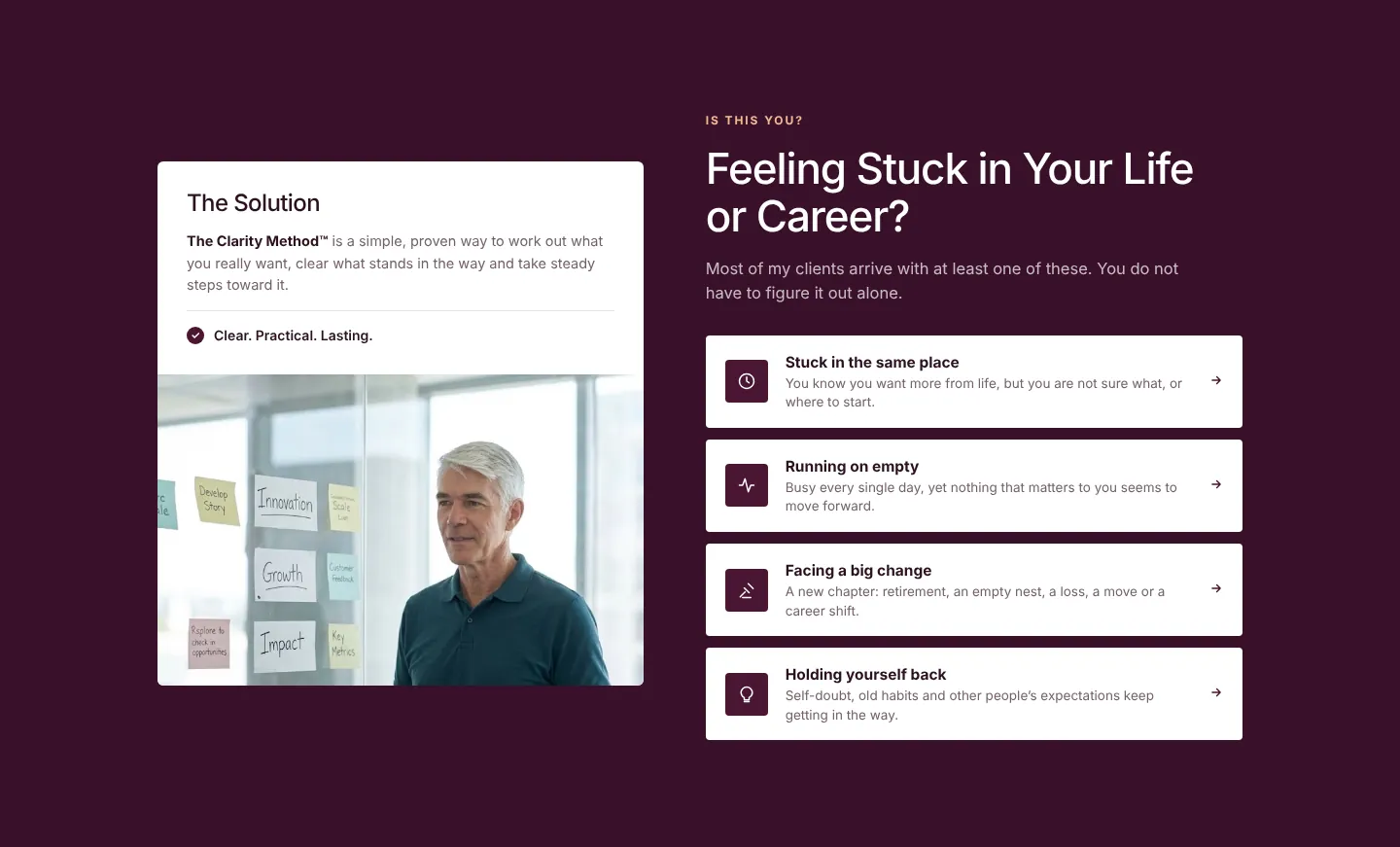
The Coach template introduces "The Clarity Method" in a card, with a one-line promise, right next to the four problems clients arrive with.
This layout puts the framework's name and promise beside the problems it solves. A visitor reads "Feeling stuck? Running on empty?", recognises themselves, then sees the named method as the answer. It's ideal for coaches and speakers whose framework is their main offer.
The numbered step grid
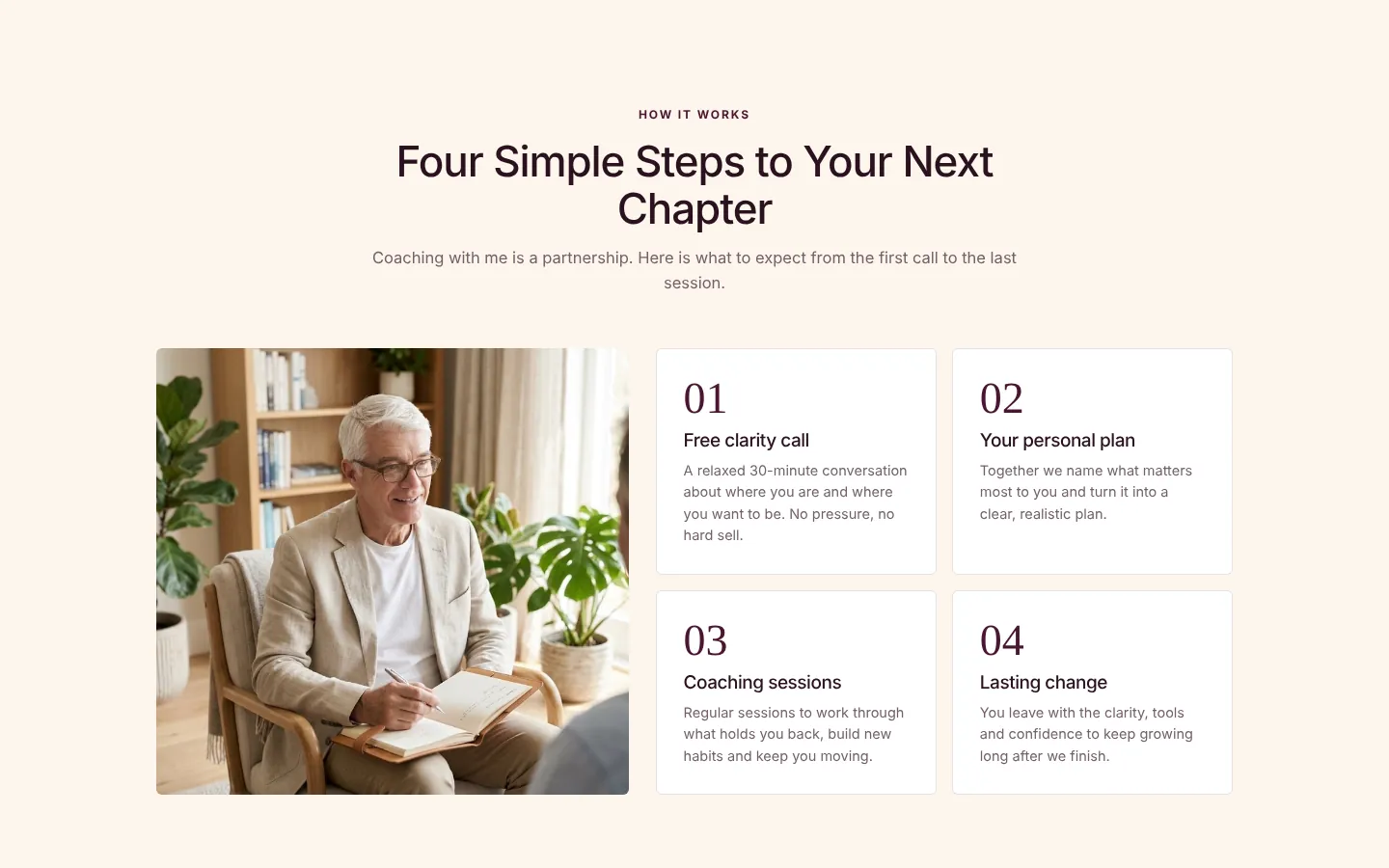
The Coach template's "Four Simple Steps" section: four numbered cards, each with a short title and one or two lines of explanation, beside a photo.
A numbered grid is the most direct way to show a step framework on a website. Each card holds one step: a number, a name and a short explanation, the same as blocks 4 and 5 on your one-page version. Four steps fit neatly in a two-by-two grid on desktop and stack in order on a phone.
The expandable step list
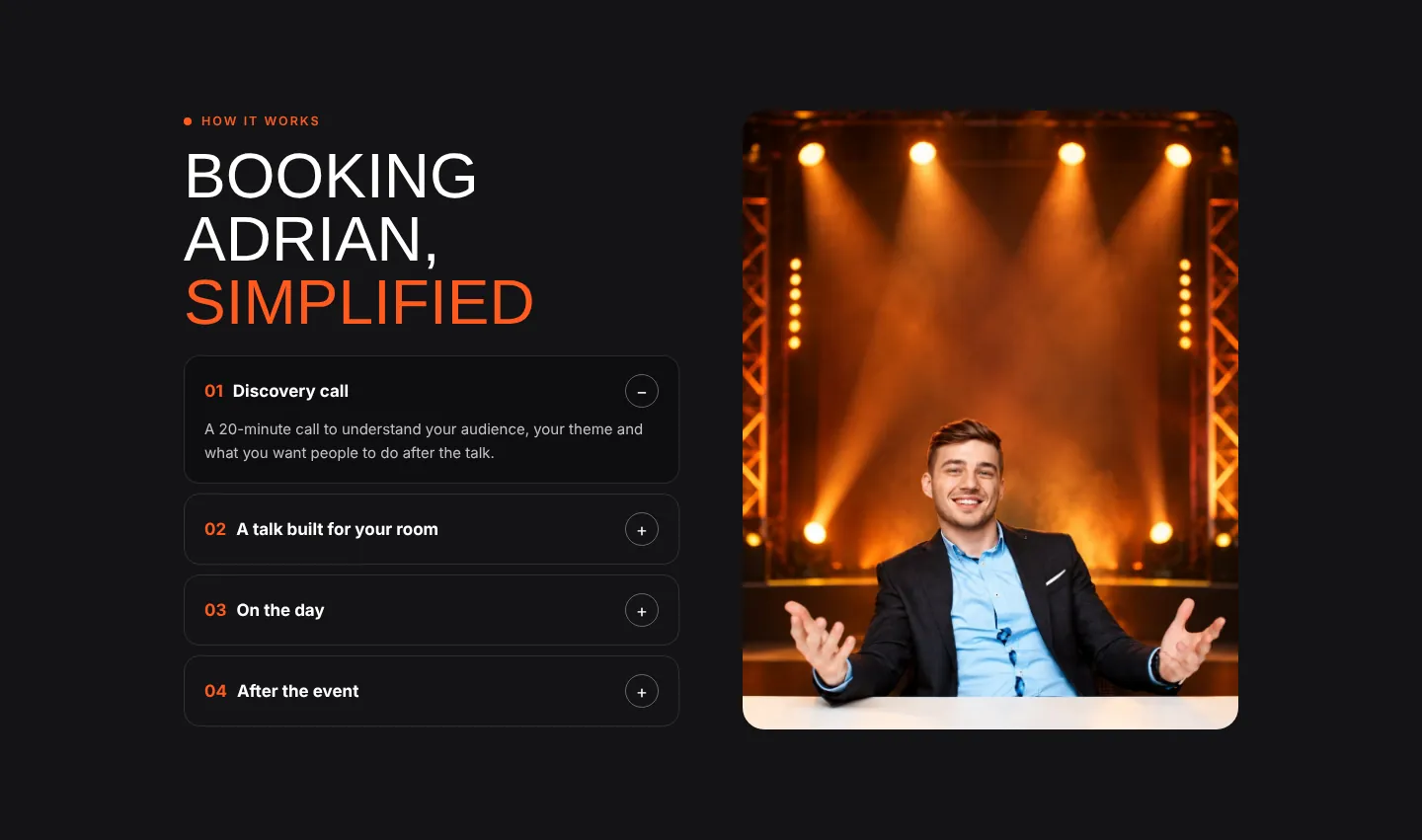
The Ignite template's "How it works" section: four numbered steps in an accordion, with the first one open and a stage photo alongside.
An accordion shows all the step names at once and lets visitors open each one for more detail. It's a good fit when each part of your framework needs more explanation than a card allows, such as the question, action and result for each step.
The two-part method with proof
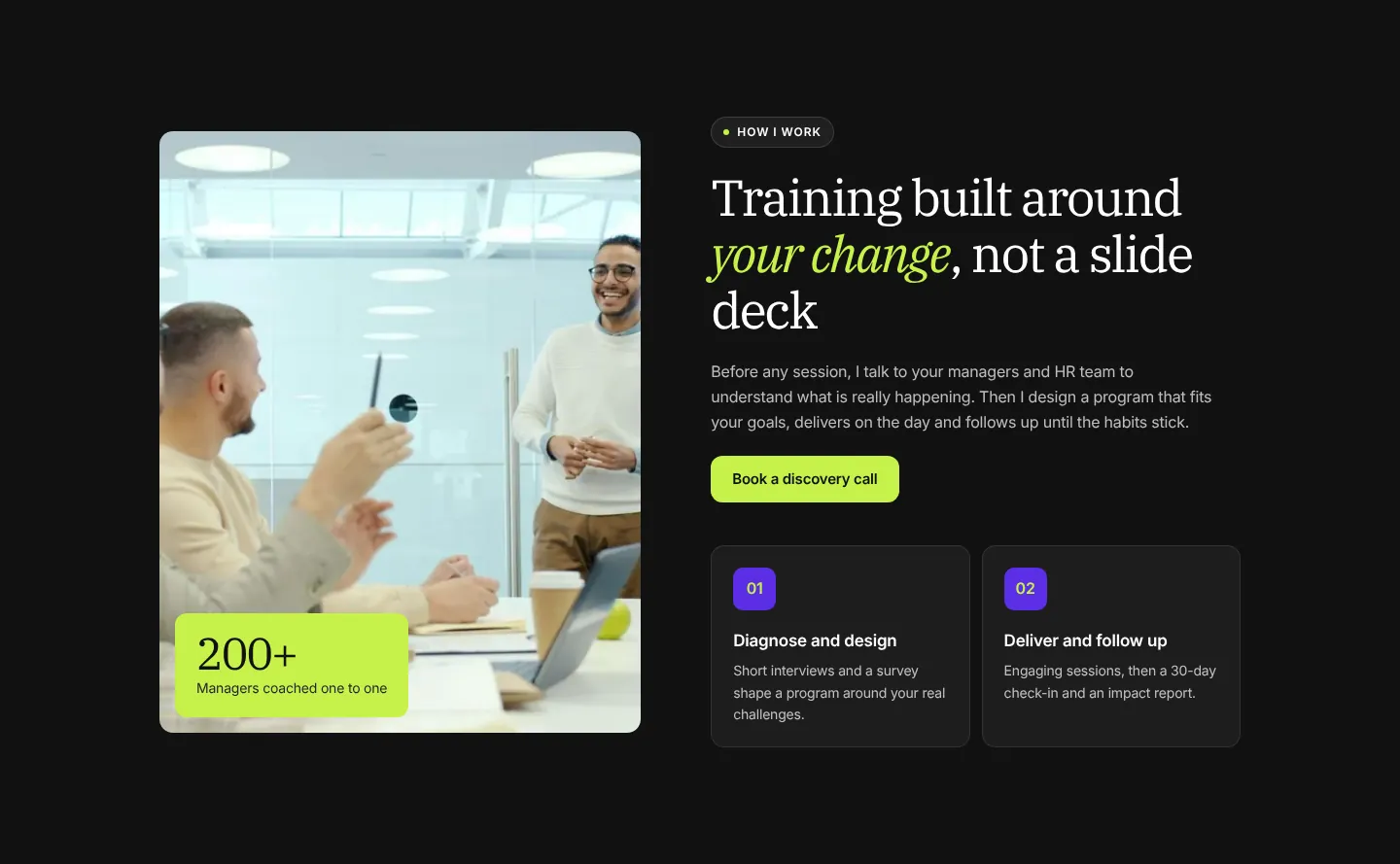
The Trainer template's "How I work" section: a headline, a short explanation, two numbered steps and a proof number on the photo.
This layout pairs a short method with a single proof number ("200+ managers coached one to one"). It works well for simple frameworks and for showing how you deliver your framework: diagnose, then deliver and follow up.
For more ideas on structuring the rest of your site, see our keynote speaker website examples, with eight layouts that get speakers booked.
Free one-page leadership framework template
Use this table to draft your framework before you design it. Fill in each row, keep each line as short as the example, then lay it out using the structure from the 4R page.
| Block | What to write | Example |
|---|---|---|
| Name | A name people can say and search | The 4R Change Framework |
| Promise | Who + what they do + what changes | Four moves managers make to keep their teams focused, calm and staying when things change |
| Use it when | The situation it's built for | A merger, restructure or new leader lands |
| Shape | Steps, cycle, pyramid, matrix, pillars or acronym | Steps, because the order matters |
| Parts | 3 to 5 names | Reason, Roles, Rhythm, Recognition |
| Meaning | One plain sentence per part | Set a steady beat of updates so silence never fills with worry |
| Ask | One question per part | When will they hear from me next? |
| Do this week | One action per part | A fixed weekly 10-minute team update |
| You'll see | One result per part | Calmer meetings, earlier warnings |
| For | Who uses it | Managers going through a merger or restructure |
| Delivered as | Your keynote, workshop or program | Keynote: Leading Through Change |
| Tools inside | Worksheets, scripts, templates | One-message line, change one-to-one script |
| Proof | One number or named quote | 87% still use a tool 30 days later |
Download the free template: one-page leadership framework PDF template (landscape, 1 page). Use it as a layout guide and rebuild it with your own framework in Canva, Google Slides or PowerPoint.
Common mistakes when presenting a leadership framework
- Too many parts. Seven or more, and people stop remembering any of them.
- Jargon instead of plain words. "Holistic alignment" means nothing to a busy manager.
- A shape that doesn't match the idea. A cycle for something that only happens once, or a pyramid where every level is equally important.
- No actions. A framework people can admire but not use won't change behaviour, and won't get rebooked.
- A forced acronym. If one letter needs an obscure word, rename the framework instead.
- Different versions everywhere. Four steps on your website, five in your deck and three in your book confuse buyers. Keep one version.
- Hiding it. If your framework only appears on slide 23, planners never see it. Put it on your website and your one-sheet.
- Over-designing. Gradients, icons and illustrations everywhere make the page harder to read. The structure should do the work.
How Speakerfolio helps leadership speakers present their framework
A one-page leadership framework is one of the clearest ways to show what makes your work different. Your speaker website should show it too.
Speakerfolio writes and builds a free one-page speaker website from your LinkedIn profile, on yourname.speakerfolio.com. Tell us about your framework and we'll present it in a section like the ones above, alongside your talks, speaker reel, testimonials and a booking form. You also get a profile in the Speakerfolio speaker directory, where event planners search for leadership speakers by topic and format.
- Free: any of six speaker website templates, written and built for you, usually within two working days
- No commission: booking requests go straight to your inbox
- Premium ($100 a year): your own domain, a custom design and more pages, including a full page for your framework, with hosting and updates included
Frequently asked questions
How do you present a leadership framework on one page?
Give it a name and a one-sentence promise, choose a shape that matches how it works, limit it to three to five parts, explain each part in one line, add a question, an action and a result for each part, then add who it's for, how it's delivered and one piece of proof.
How many parts should a leadership framework have?
Three to five parts works best for most leadership frameworks. It's enough to be useful and few enough to remember without notes.
What's the best shape for a leadership framework?
The best shape matches how your idea works: steps for an order, a cycle for repeating habits, a pyramid for levels that build on each other, a 2×2 matrix for two factors, pillars for equal parts and an acronym when recall matters most.
Should my leadership framework be an acronym?
Only if the letters come naturally. A good acronym helps people remember the framework, but a forced one with weak words hurts clarity. A clear plain name is better than a clever acronym.
What tool should I use to design a one-page framework?
Canva, Google Slides, PowerPoint, Keynote or Figma all work. If you present with slides, design it as a single slide so you can use it in your talk and export it as a PDF handout.
Should I put my leadership framework on my speaker website?
Yes. It shows planners and buyers what makes your approach different, helps them match you to their event, and gives attendees a place to find it after your talk.
How do I protect my leadership framework?
Use your name on it, publish it consistently on your website and in your materials, and keep records of when you created it. For formal protection of a name or logo, speak to an intellectual property lawyer in your country about trademarks.
Put your framework on one page this week
Your leadership framework is probably the most valuable thing you teach. Give it a name, a promise and a shape, keep it to three to five parts, and make every part something a manager can do this week. Then use the same page everywhere: on stage, in handouts, in proposals and on your website. Download the free one-page leadership framework PDF template to start, and get your free speaker website from Speakerfolio to show your framework to the planners who book you.

Saleh is a UI/UX and web designer with more than five years of experience and the founder of Speakerfolio, where he builds websites that help speakers get booked. He specialises in conversion-focused design and on-page SEO.
Connect on LinkedInRelated articles
All articles