Storytelling for Leaders: 7 Lessons from Karen Eber's TED Talk on How the Brain Responds to Stories
Why storytelling matters for leaders: 7 lessons from Karen Eber's TEDx talk on how the brain responds to stories, plus a worksheet for mixing story and data.
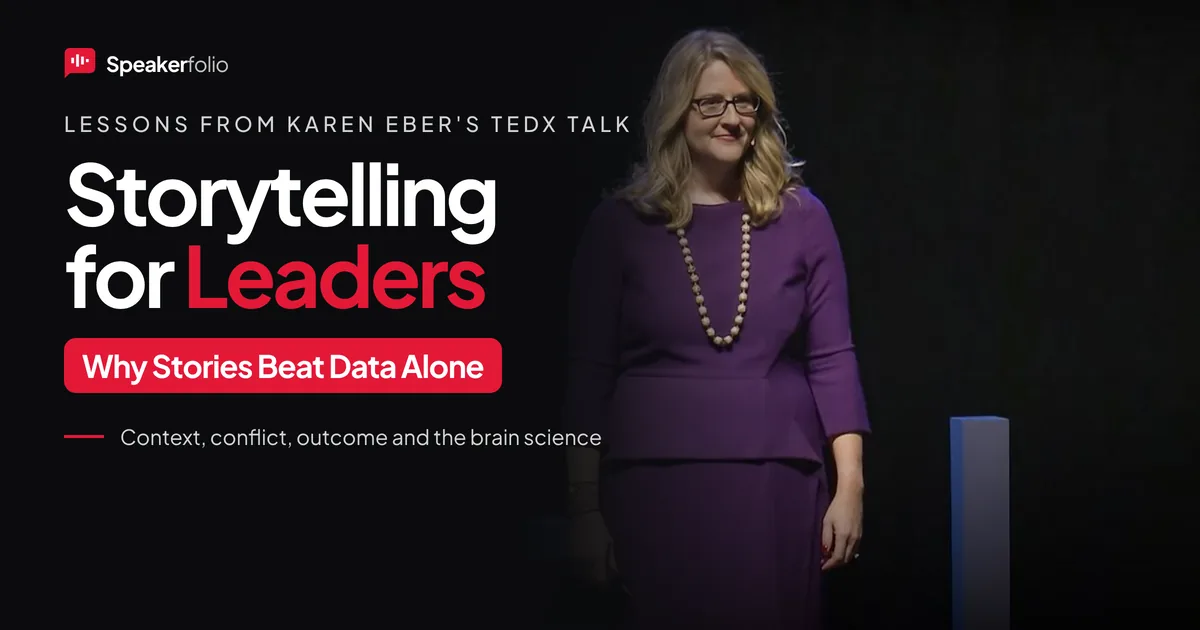
Leaders should tell stories alongside their data because data informs people, but stories are what make them care and act. In her TEDxPurdueU talk, leadership consultant Karen Eber explains that a story engages far more of the listener's brain than a list of facts, builds empathy and trust in the speaker, and gives people a way into numbers they would otherwise forget. Her method is simple: start with the problem you want to solve, pick a story with a clear context, conflict and outcome, and use it to carry your data rather than replace it. Below are seven lessons from the talk, with a planning worksheet and examples you can use in your next presentation. If you speak for a living, Speakerfolio gives you a free speaker website where your own talks and stories can find an audience.
Key takeaways - Story and data are not either-or. Eber calls them a "power ballad": data is the melody, story the harmony. - People decide with emotion first and explain with logic afterwards, so data alone rarely changes behaviour. - A useful story answers three questions: what's the context, what's the conflict, and what's the outcome? - Before you open your slides, decide what you want people to think, feel and do differently.
Watch the talk: How your brain responds to stories
Karen Eber's talk was recorded at TEDxPurdueU in February 2020 and has been played more than 2.2 million times on TED.com. It runs just under 14 minutes.
You can also watch it on YouTube or read the full transcript on TED.com. This article summarises the ideas in our own words and adds practical steps for applying them.
Who is Karen Eber?
Karen Eber is an author, keynote speaker and the CEO and Chief Storyteller of Eber Leadership Group. Before consulting, she was Head of Culture and Chief Learning Officer at General Electric and Head of Leadership Development at Deloitte. At GE she was responsible for shaping culture in a business of about 90,000 employees in 150 countries, which is where she noticed how well stories worked across very different audiences.
She wrote The Perfect Story: How to Tell Stories that Inform, Influence, and Inspire (Harper Horizon, 2023). She gives keynotes and workshops on storytelling, storytelling with data, leading through change and organisational culture. You can find her work at kareneber.com.
Lesson 1: Most leaders avoid stories, and for three reasons
Eber says leaders are often "allergic" to storytelling. In her experience, the resistance comes from three places:
- They don't know where to find stories. They assume a story must be dramatic or personal.
- They don't know how to tell them. They worry it will sound rambling or unprofessional.
- They think there's no room. The meeting is about numbers, so they present numbers.
Her point is that all three are solvable, and that the third one is the real trap. Treating story and data as competitors for the same time slot is what makes presentations forgettable.
The talk opens with an everyday example. An employee drops her phone down the gap of an office lift, and a security guard she always greets finds a way to get it back for free. Eber pairs it with a well-known account from the CEO of Charles Schwab, who failed a university exam that asked for the name of the person who cleaned the classroom. Neither story is dramatic. Both make a clear point about leaders noticing people, and both stick far better than a slide titled "Recognition matters".
Lesson 2: A story lights up more of the brain than a lecture
Here is the neuroscience Eber walks through, in plain terms:
- In a lecture or meeting, the language areas of the brain do most of the work (she names Wernicke's and Broca's areas). That's processing, and she notes that people forget much of it soon afterwards.
- When you hear a story, many more areas activate as your senses and emotions get involved. If the speaker describes a phone hitting the floor, the parts of your brain that handle seeing and hearing respond as though you'd witnessed it.
- Neural coupling is the term for the listener's brain activity starting to mirror the storyteller's. It's why you can sit still in a cinema while your heart races.
- Empathy builds trust. As you feel for the storyteller, your brain releases oxytocin, and Eber explains that this makes you see the speaker as more trustworthy.
For a leader, that last point is the big one. The act of telling a good story doesn't only make your message clearer. It changes how much people trust the person delivering it.
Lesson 3: Data doesn't change behaviour; emotions do
Eber's most practical argument is that facts alone rarely move people. Her example is one everyone recognises: if information changed behaviour, we would all sleep eight hours, exercise and floss every day.
She describes decision-making as starting in the brain's emotional centre, below conscious awareness. By the time we're aware of a choice, we're already busy explaining it with logic. That's why we believe our decisions are rational.
To show how central emotion is, she mentions the neuroscientist Antonio Damasio. He studied patients whose brain damage left them unable to experience emotion. They were capable in every other way, yet they struggled to make even simple decisions.
What this means for your next presentation:
| If your goal is to... | Data alone tends to... | Story plus data tends to... |
|---|---|---|
| Get budget approved | Inform the room | Make the room care about the problem |
| Change a habit or process | Explain why it matters | Help people picture themselves doing it |
| Win support for a change | Show the gap | Make the gap feel urgent and personal |
| Build trust as a new leader | Prove competence | Show who you are and what you value |
Lesson 4: Data never speaks for itself
The second misconception Eber tackles is the idea that "the numbers speak for themselves". They don't. Our brains love to predict, so when we see a chart we fill the gaps with our own experience and bias. Ten people can read the same graph and leave with ten different conclusions.
A story gives the audience a path through the data. It tells them which number matters, why, and what to feel about it. Without that path, you're leaving the meaning of your presentation to chance.
Lesson 5: Great stories answer three questions and do three things
This is the toolkit at the centre of the talk. Eber says a good story answers three questions:
| Question | What it covers | Example prompt |
|---|---|---|
| Context | The setting, who's involved and why we should care | "It was the week before our biggest product launch..." |
| Conflict | The moment where something goes wrong or changes | "...when our lead engineer resigned." |
| Outcome | What's different now, and the takeaway | "...and what we learned about building teams that don't rely on one person." |
And a good story has three qualities:
- It builds and releases tension. The listener keeps wondering what happens next, and the story pays that off with something unexpected, more than once.
- It builds an idea. It leaves the audience seeing something they can't unsee.
- It communicates value. It shows what you encourage and what you don't. Eber cites research from Stanford that names storytelling as one of the best ways to shape organisational culture.
If your story is missing the conflict, it's an anecdote. If it's missing the outcome, it's a cliffhanger. You need all three.
Lesson 6: Start with the problem, not the slides
One of the most useful moments in the talk is Eber's account of a CEO preparing for her annual company meeting. She arrived with 45 slides of data for a 45-minute talk.
Instead of sorting the slides, Eber set them aside and asked three questions:
- What's the problem you're trying to solve?
- What do you want people to think and feel differently afterwards?
- What do you want them to do differently?
Those answers became the framework for both the story and the data. The CEO wanted the company to break into new markets to stay competitive. She told a story about her daughter, a gymnast competing for a scholarship who had to keep learning harder routines to stay in contention. Then she brought in the business data.
That example shows the two choices Eber gives every presenter:
| Story type | What it is | When it works best |
|---|---|---|
| A story about the data | The story is the real case behind the numbers: a customer, an employee, a project | When you have a strong real example and an audience that wants specifics |
| A parallel story | A story from another area of life that mirrors the point you're making | When the data is abstract, sensitive or confidential, or you need a fresh angle |
Lesson 7: Let the story open the door, then bring in the numbers
The talk's closing example is about a university adviser who had to present to senior leadership. A large share of the university's students with autism weren't graduating. Her leaders kept telling her to focus on the data, but she knew they already had it. What they didn't have was a reason to stop overlooking it.
So she opened with the story of one student, her struggles navigating university and what changed when an adviser adapted to her needs. Only then did she share the numbers: the low graduation rate, the reason behind it and the lifetime cost of not finishing a degree. Her ending revealed a personal connection that made the whole room stop.
The lesson for presenters is the order. The story earned attention. The data then landed on people who were ready to care about it.
How to apply Eber's method to your next presentation
You don't need a dramatic life story. You need a clear goal, one well-built story and the right data. Use this worksheet the next time you prepare a talk, a board update or a team meeting.
Story and data planning worksheet
- The problem: What problem am I trying to solve with this presentation?
- Think: What do I want people to think differently?
- Feel: What do I want them to feel?
- Do: What one action do I want them to take?
- The story: Is it a story about the data or a parallel story?
- Context: Where and when does it happen, who's involved, and why should this audience care?
- Conflict: What's the moment where things change?
- Outcome: What's different now, and what's the takeaway?
- The data: Which three numbers support the point? Which can I cut?
- The close: What line connects the story, the data and the action?
Here's how that might shape a 10-minute talk:
| Time | Section | What you do |
|---|---|---|
| 0:00 to 2:30 | Story | Open with context and conflict; hold back the outcome |
| 2:30 to 3:30 | Outcome | Resolve the story and name the idea it shows |
| 3:30 to 7:00 | Data | Two or three numbers that prove the idea is bigger than one example |
| 7:00 to 9:00 | Meaning | What this means for your audience, in their terms |
| 9:00 to 10:00 | Action | One clear ask, linked back to the story |
Where to find stories when you think you have none
Eber's broader point is that stories are everywhere once you start looking. Good sources include:
- A customer complaint that changed how your team works
- The first week in a new role and what surprised you
- A project that nearly failed, and the moment it turned
- Something a colleague did that showed your values in action
- A moment from outside work, such as sport, parenting or travel, that mirrors your point
- A story you read about another leader, credited properly
Keep a running note on your phone. When something makes you think "that's exactly what I mean", write down the context, conflict and outcome in three lines.
Common mistakes when mixing stories and data
| Mistake | Why it fails | Fix |
|---|---|---|
| Starting with the slides | You lose the big picture and the audience follows | Answer the think, feel and do questions first |
| A story with no conflict | It becomes a pleasant anecdote people forget | Find the moment where things changed |
| Too many numbers | Nothing stands out | Keep the two or three that prove your point |
| A story unrelated to the point | The audience enjoys it but misses the message | Link the outcome directly to your data and ask |
| Waiting for the perfect story | You never tell one | Use a good-enough story and refine it each time |
That last row is Eber's closing advice in the talk. As she puts it: "Don't wait for the perfect story. Take your story and make it perfect."
Why this matters for professional speakers
If you speak for a living, Eber's talk is also a lesson in how to market yourself. Event planners and companies are trying to judge, quickly, whether your talk will hold a room. A few things help:
- Show a story on your speaker page. A short video clip where you tell one story well does more than a paragraph of claims.
- Describe talks by the change they create. Use the think, feel and do structure: what the audience will understand, feel and do differently afterwards.
- Pair proof with a story. One testimonial that describes a moment in your talk is more persuasive than a list of client logos.
If you want ideas on structuring your talks themselves, our guide on how to improve public speaking covers delivery, and these keynote speaking tips gather lessons from other well-known speakers.
How Speakerfolio helps speakers share their stories
Speakerfolio helps speakers put their talks, stories and proof in one place that planners can check in a minute.
- A free speaker website. A professional site on your own Speakerfolio address with your talks, videos, testimonials, bio and a booking form that sends enquiries straight to you. Pick from our speaker website templates and we set it up for you.
- A listing in the speaker directory. Event planners can browse the Speakerfolio speaker directory by topic, including leadership and communication, and contact you directly with no agency fees.
- Premium when you're ready. For $100 a year, Premium gives you a custom design on your own domain with as many pages as you need, with hosting and updates included.
To get a page for your talks and stories, request your free speaker website.
Frequently asked questions
Why is storytelling important for leaders?
Stories help people connect with information, remember it and act on it. In her TED talk, Karen Eber explains that stories engage more of the brain than facts alone, build empathy and increase trust in the speaker, which makes storytelling one of the most useful skills a leader can have.
What happens in the brain when we listen to a story?
According to Eber, listening to a lecture mainly activates the brain's language areas, while a story activates many more areas as senses and emotions get involved. The listener's brain activity starts to mirror the storyteller's, which she calls neural coupling, and the empathy this creates releases oxytocin, which builds trust.
Should I use stories or data in a presentation?
Use both. Eber's view is that story and data work together: data provides the evidence, and the story gives people a reason to care and a path through the numbers. Start with the problem you want to solve, then choose a story and the few data points that support it.
What are the three parts of a good story?
Eber says a good story answers three questions: what's the context (the setting, who's involved and why we should care), what's the conflict (the moment things change), and what's the outcome (what's different and what the takeaway is).
What is a parallel story?
A parallel story comes from a different area of life but mirrors the point you're making. Eber's example is a CEO who told a story about her daughter learning harder gymnastics routines to stay competitive, then used it to explain why the company needed to break into new markets.
How long is Karen Eber's TED talk?
Her talk, "How your brain responds to stories, and why they're crucial for leaders", runs just under 14 minutes. It was recorded at TEDxPurdueU in February 2020 and is available on TED.com and YouTube.
What book did Karen Eber write about storytelling?
Karen Eber wrote The Perfect Story: How to Tell Stories that Inform, Influence, and Inspire, published by Harper Horizon in 2023. It explains how to apply the science of storytelling, including telling stories with data.
Make your next presentation a story with data
Karen Eber's talk makes a simple case: people don't act on information they don't care about. Before your next presentation, put the slides aside, decide what you want people to think, feel and do, and find one story with a clear context, conflict and outcome to carry your data. Then watch her talk and see how she does it. If you speak professionally and want a place to share your own talks and stories, get your free speaker website on Speakerfolio.

Saleh is a UI/UX and web designer with more than five years of experience and the founder of Speakerfolio, where he builds websites that help speakers get booked. He specialises in conversion-focused design and on-page SEO.
Connect on LinkedInRelated articles
All articles