Free Website for Creativity and Innovation Speakers: A Site That Looks the Part
Get a free website for creativity and innovation speakers: reel, keynote topics, brands, testimonials and a booking form, built for you on the Studio template.
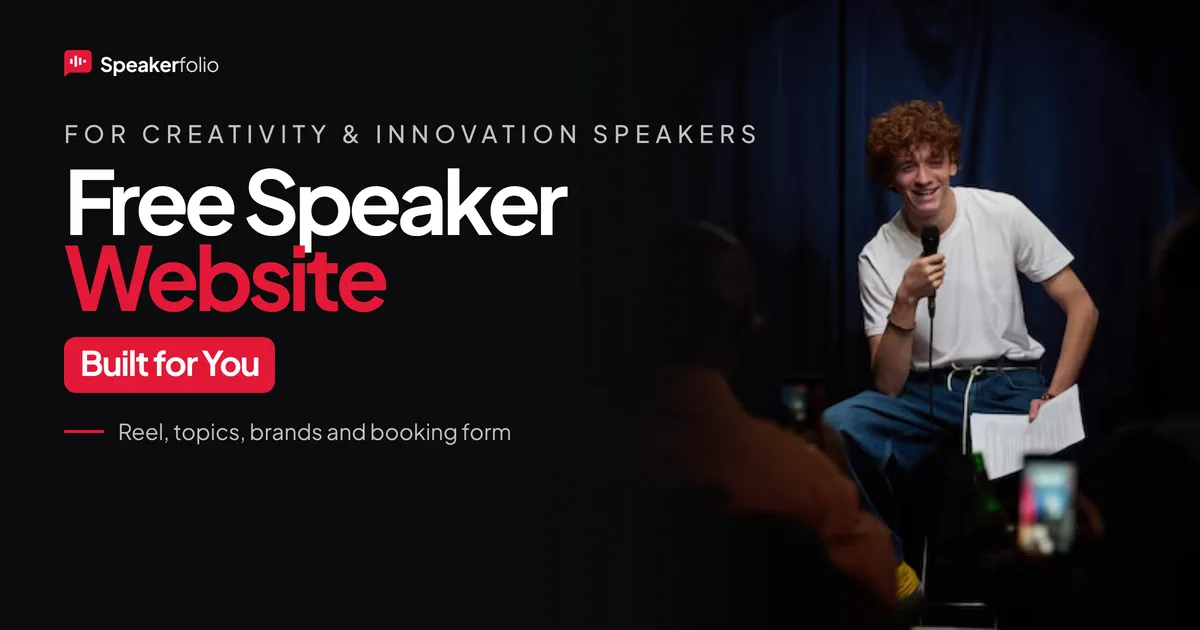
Creativity and innovation speakers can get a professional website for free. Speakerfolio writes and builds a one-page speaker site from your LinkedIn profile, with your keynote topics, a speaker reel, the brands and events you've worked with, testimonials and a booking form. It goes live on yourname.speakerfolio.com, usually within two working days, and you're listed in the Speakerfolio speaker directory at no cost. The Studio template was designed for creative speakers, with a bold reel section, a gallery-style formats area and room for your book and press. When you want your own domain and more pages, Premium is $100 a year.
Key takeaways
- Creative speakers are judged on taste. A plain, template-looking site works against you, so design matters more on this topic than most.
- Planners still need the basics: clear topics, a reel, proof and a way to book you, all within a scroll or two.
- Speakerfolio builds the site for you from your LinkedIn profile, with no card and no trial period.
- Show the work, not just the words. Projects, campaigns, stages and press do more than adjectives like "innovative".
Why creativity and innovation speakers need a website that looks the part
If you speak about creativity, your website is part of your pitch. An event planner who books you to help their teams think differently will judge your ideas partly by how your own page looks and reads.
That cuts both ways. A cluttered or generic site makes even strong ideas look ordinary. A clear, confident one tells planners you practise what you teach before they've watched a second of your reel.
But design alone doesn't get you booked. Planners still have practical questions:
- What do you actually speak about? "Creativity" and "innovation" are broad. Planners want specific topics they can put in an agenda.
- Who is it for? Marketing teams, product teams, leadership offsites, design conferences or the whole company.
- How do you come across on stage? They want to see and hear you, ideally in under two minutes.
- Who has trusted you before? Brands, festivals, conferences and press.
- How do they book you? Without a chain of emails.
The best creativity speaker websites answer all five with the same care they bring to the design.
Who books creativity and innovation speakers
Creativity and innovation talks are booked by a wide mix of organisations. Knowing who you're writing for shapes every section of your site.
| Who books | Typical events | What they want from a speaker |
|---|---|---|
| Corporate events and internal comms teams | Company conferences, all-hands, kick-offs | Energy, fresh thinking and ideas teams can use on Monday |
| Innovation and strategy leaders | Innovation weeks, hackathons, leadership offsites | Practical methods for turning ideas into action |
| Marketing and creative teams | Agency days, brand summits, creative retreats | Inspiration grounded in real campaigns and work |
| Design and creative conferences | Festivals, industry events, award shows | A distinctive voice and a talk people will discuss afterwards |
| Learning and development teams | Leadership programs, workshops | Repeatable tools, exercises and follow-up |
| Universities and cultural organisations | Lectures, galleries, festivals | Ideas, stories and a strong point of view |
A good site speaks to several of these at once, with topics and formats that make the fit obvious.
What's on the free Speakerfolio site for creativity speakers
Every free Speakerfolio website is a single page, written and built for you. For creativity and innovation speakers, it usually includes these sections:
| Section | What it shows | Why it matters |
|---|---|---|
| Hero | Your name, a clear headline and a booking button | Planners see your point of view in seconds |
| Reel | A short video of you on stage | Shows energy, humour and presence |
| Brands and events | Logos or names of clients, festivals and conferences | Instant credibility |
| About | Your story and the work behind your ideas | Shows you've done creative work, not just talked about it |
| Numbers | Keynotes, countries, views, years of experience | Scannable proof |
| Testimonials | Quotes from named organisers and clients | Answers "will this land with our people?" |
| Keynote topics | Titles, a one-line promise and details for each | Turns "creativity" into something bookable |
| Formats | Keynotes, workshops, festival talks and more | Shows the ways to work with you |
| Book and press | Your book, podcast appearances and media | Depth and authority |
| Booking form | Event date, format, audience and a message | Turns interest into an enquiry |
The free plan also includes:
- A speaker one-sheet you can send to planners
- A profile in the Speakerfolio speaker directory, where planners search by topic and format
- Basic AI visibility setup, so assistants like ChatGPT can understand who you are and what you speak about
- Limited admin access to update your details
The only condition is a small designer credit in the footer.
The Studio template, section by section
Speakerfolio's Studio template was built for creative speakers: artists, designers, creative directors and anyone who speaks about creativity, culture and innovation. Here's how each section works, using the template's fictional speaker, creative director Theo Banks.
1. A hero with a point of view
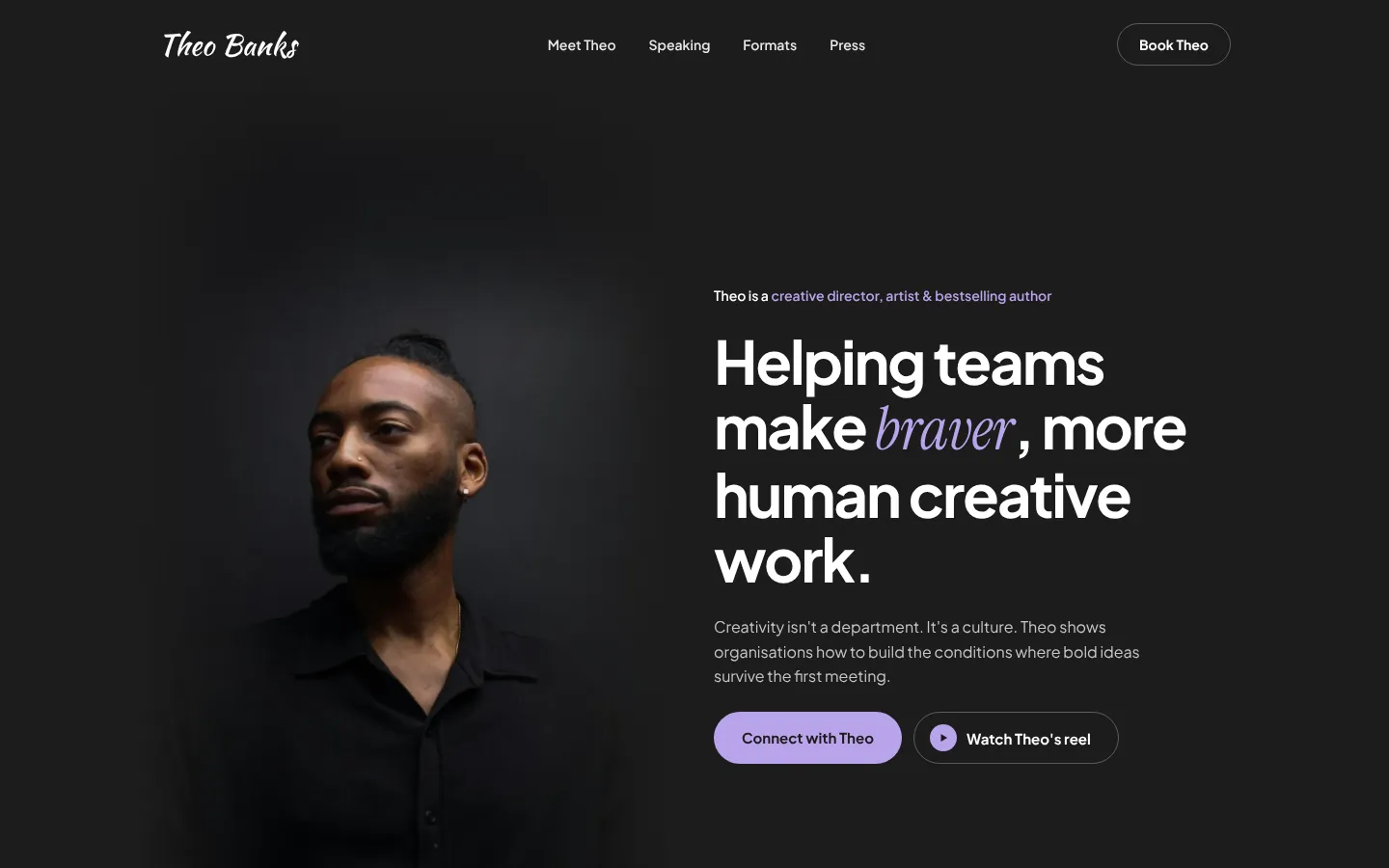
The hero leads with a belief, not a job title: "Helping teams make braver, more human creative work." One word is set in an italic serif and a soft accent colour, which gives the headline personality without shouting.
Below it, a short line sharpens the idea: creativity isn't a department, it's a culture. Then two buttons, "Connect with Theo" and "Watch Theo's reel", sit side by side, one for planners ready to enquire and one for those who want to see more first.
How to copy it: write a headline that says what you help people do, in a way that sounds like you. Use one word of emphasis, not five. Keep the supporting line to one or two sentences.
2. A full-width reel
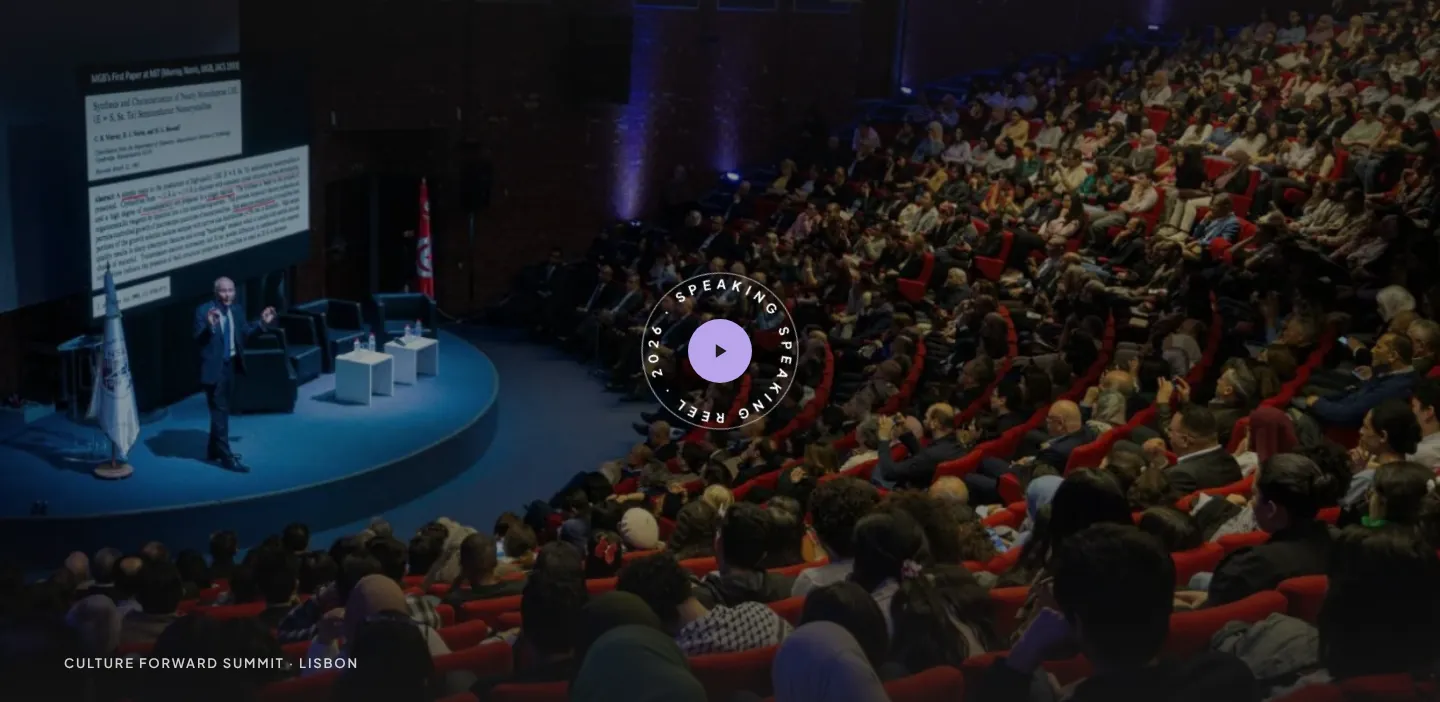
Straight after the hero, a full-width stage photo with a spinning "speaking reel" badge invites people to press play. The event name sits in the corner.
For creativity speakers, the reel matters more than almost anything else. Planners want to know whether you'll make a room laugh, think and lean in. A good clip answers that faster than any copy.
How to copy it: use your best two minutes of stage footage. Open with a strong moment, include a laugh or a reaction from the audience, and end with your name and topic. Our guide shows how to make a two-minute speaker reel from footage you already have.
3. Brands and events you've worked with
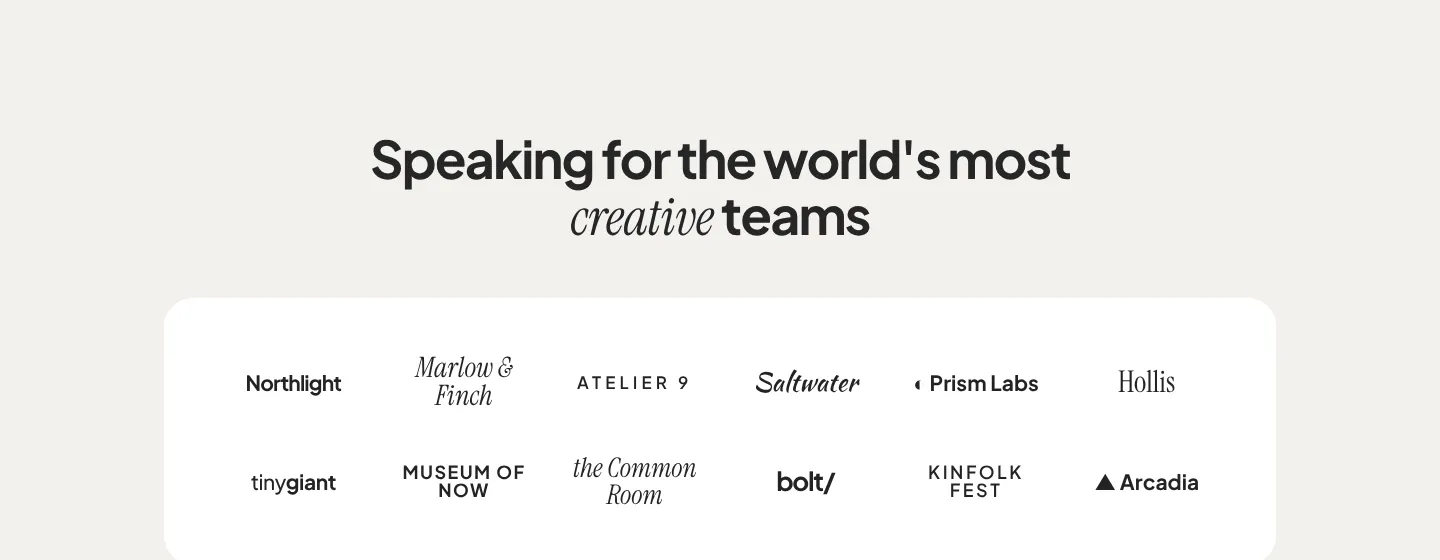
A clean card of logos, under a heading with one italic word: "Speaking for the world's most creative teams." It shows breadth: agencies, studios, festivals and cultural organisations.
How to copy it: include brands you've spoken for, worked with or consulted for, and events where you've appeared, but only ones you have permission to show. Eight to twelve logos are enough. If you're early in your speaking career, use the companies where you did your creative work.
4. About, with numbers that back it up
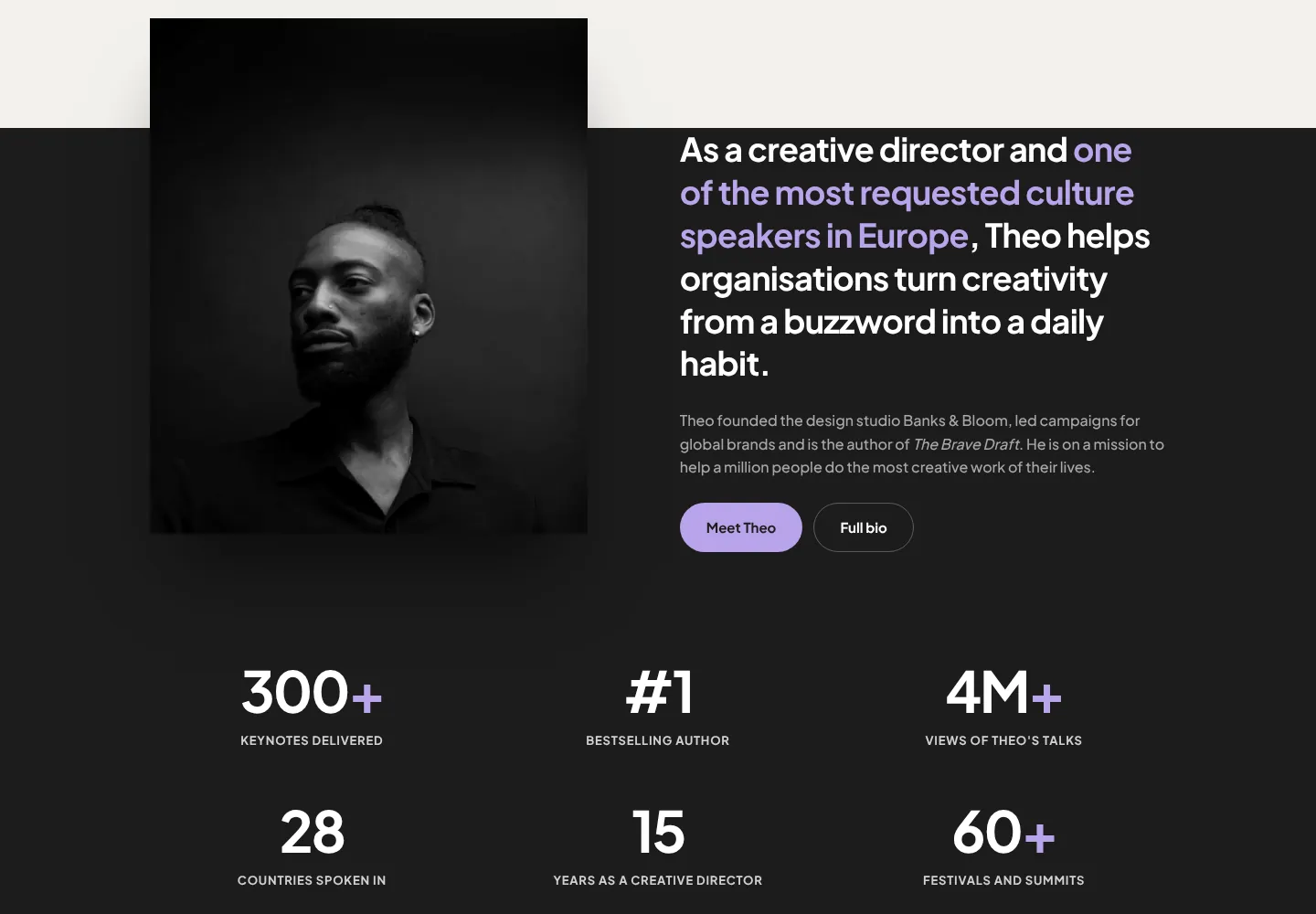
The about section pairs a portrait with a short, confident bio. A key phrase is highlighted in the accent colour. Below, six numbers fill a grid: keynotes delivered, bestselling author, views of talks, countries, years as a creative director and festivals.
The bio mentions real creative work: founding a design studio, leading campaigns for global brands, writing a book. That's what makes a creativity speaker credible. Planners want to know you've shipped ideas, not just studied them.
How to copy it: write three or four sentences about the creative work behind your talks. Then choose four to six numbers you can stand behind. "15 years as a creative director" is stronger than "passionate about creativity". If you need help, see our guide to writing a speaker bio planners can actually use.
5. A testimonial next to a stage photo
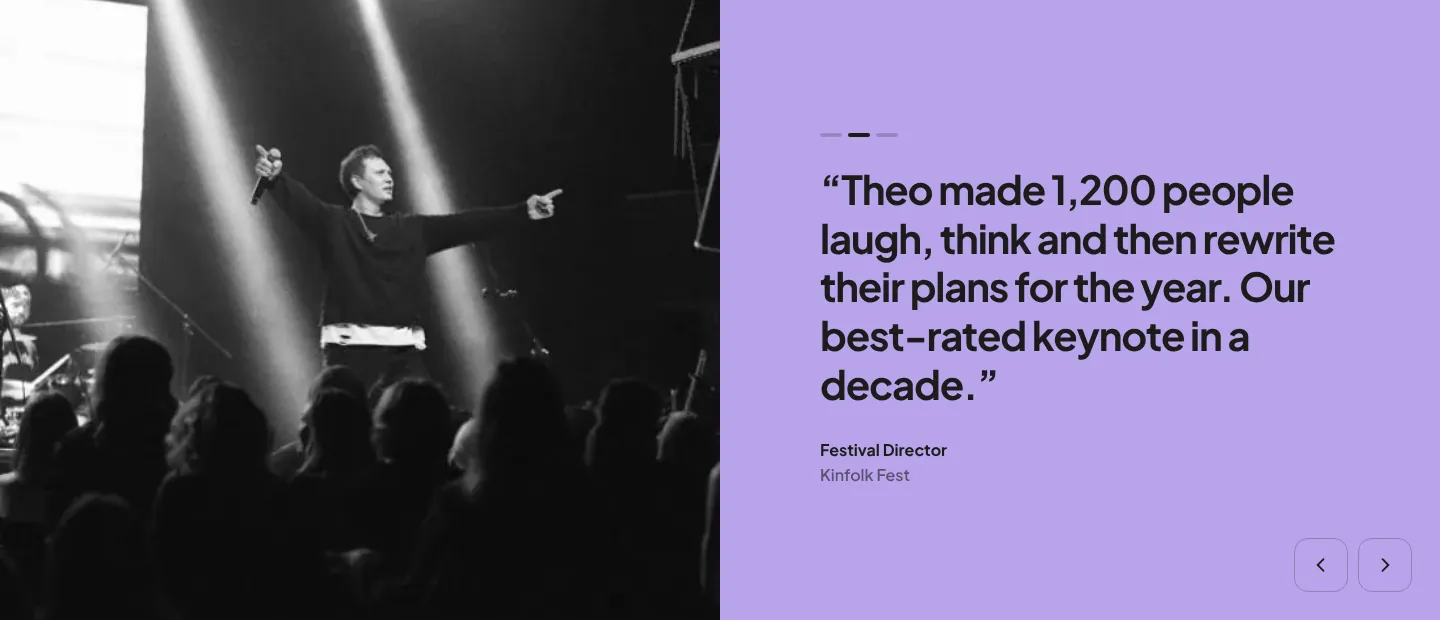
This split section puts a stage photo on one side and a large quote on the other: "Theo made 1,200 people laugh, think and then rewrite their plans for the year." The quote names the person's role and organisation, and arrows let visitors read more.
Why it works: it's specific (1,200 people), it describes a result (they rewrote their plans) and it comes from someone who books speakers.
How to copy it: pick your three best testimonials from organisers and clients. Choose ones that describe a reaction or outcome, not just "great speaker". Our guide on how to ask for testimonials has wording you can use straight after an event.
6. Keynote topics that expand
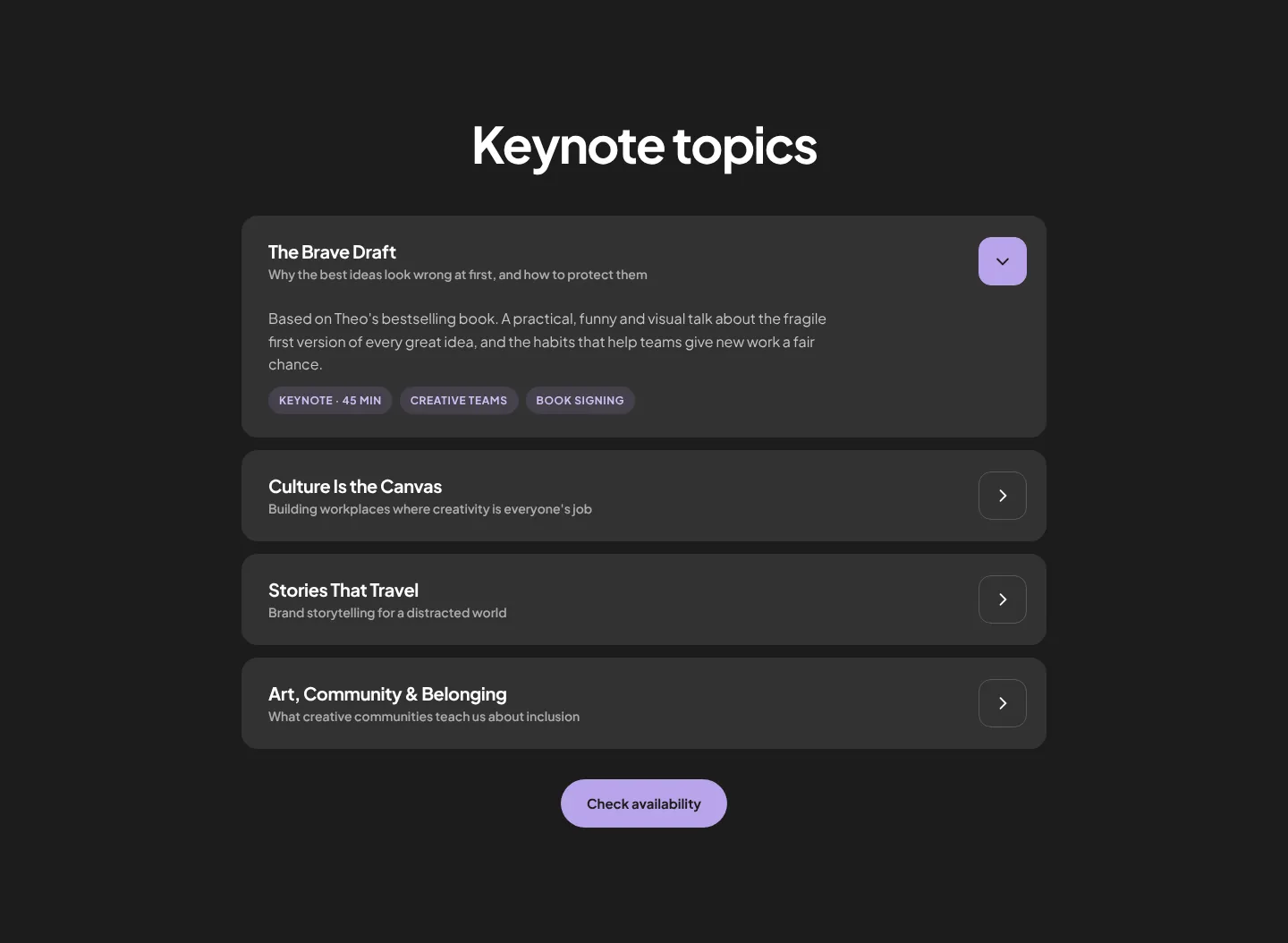
Four keynote topics are listed as an accordion: The Brave Draft, Culture Is the Canvas, Stories That Travel and Art, Community & Belonging. Each has a short subtitle. The first one is open, with a description and tags for length, audience and book signing. A "Check availability" button sits underneath.
The format keeps the page tidy while giving planners full detail when they want it.
How to copy it: list three or four topics. Give each a memorable title and a subtitle that explains the promise, such as "Why the best ideas look wrong at first, and how to protect them". Add a short description and tags for length, audience and any extras. More on titles below.
7. Formats with photos
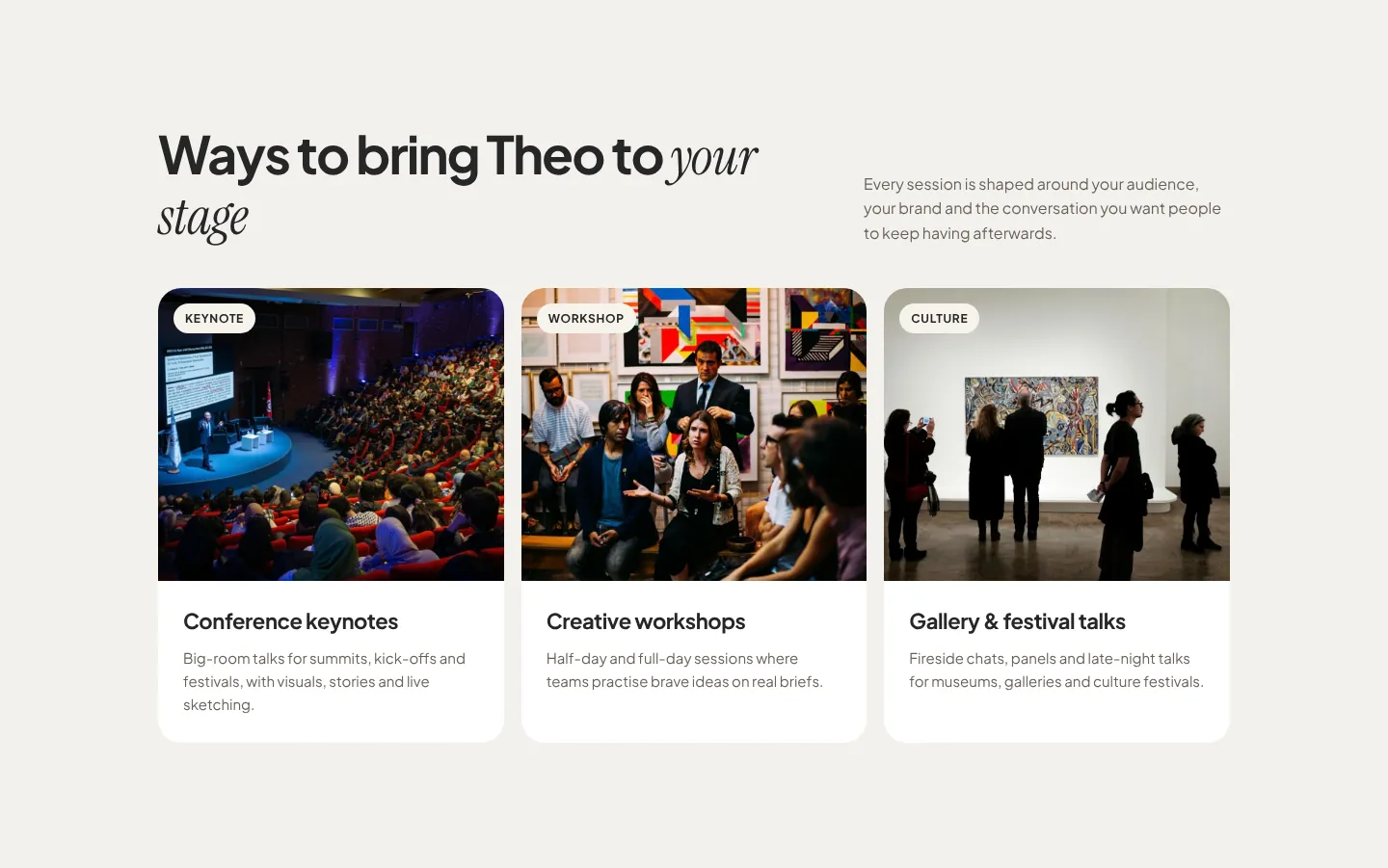
"Ways to bring Theo to your stage" shows three formats as photo cards: conference keynotes, creative workshops, and gallery and festival talks. Each has a tag, a short description and a real event photo.
For creativity speakers, workshops are often where the bigger fees and repeat bookings come from. Teams that loved a keynote want to practise the ideas.
How to copy it: show three formats with a photo, a label and one sentence each. Common options for creativity and innovation speakers include keynotes, hands-on workshops, innovation sprints, panel hosting and festival talks.
8. Book and press
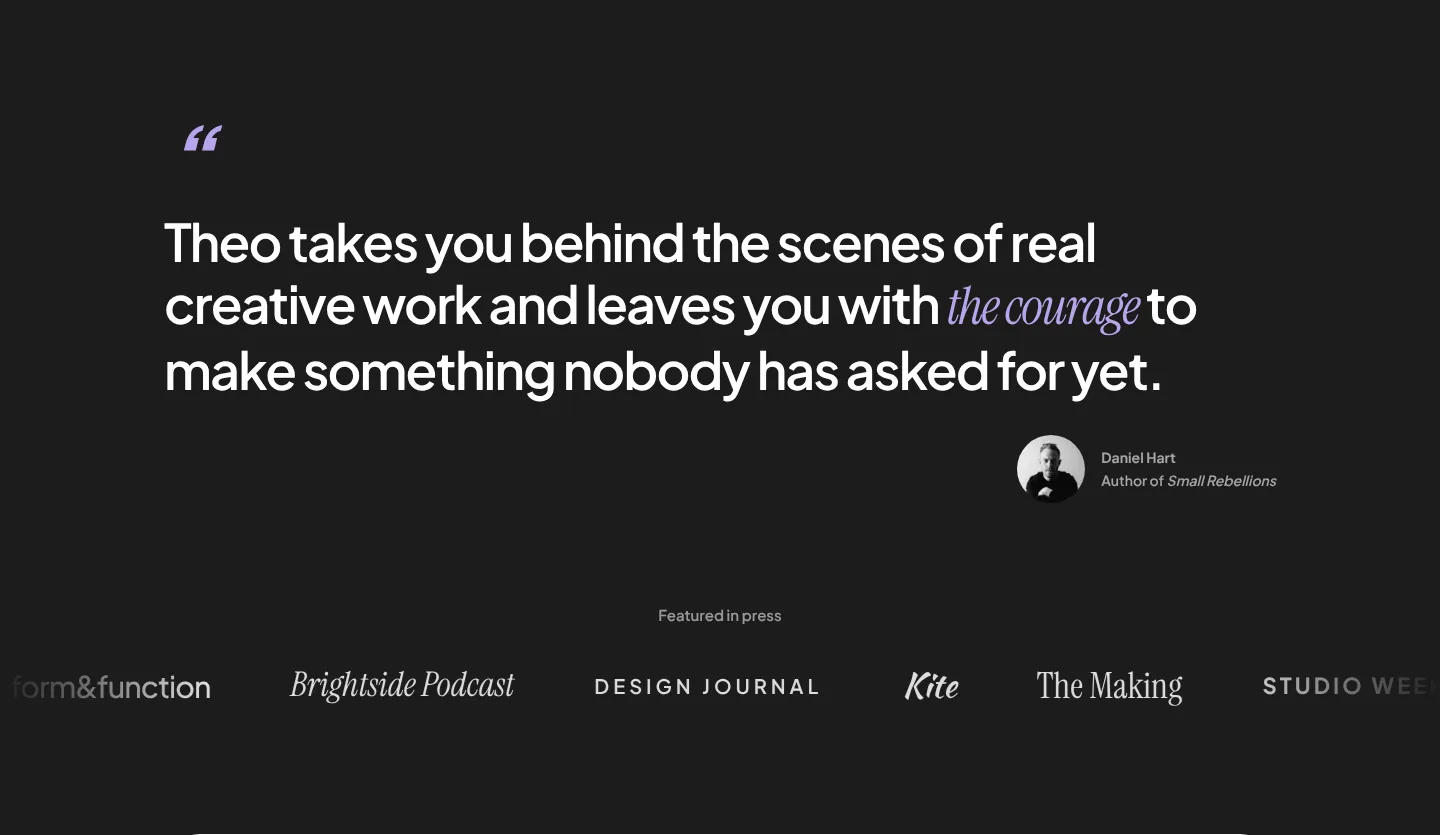
A large quote from a fellow author sits above a scrolling row of press and podcast names. It shows that other creative people respect the speaker's work, and that the media has covered it.
How to copy it: include podcasts, publications and shows that have featured you or your work. A book, a podcast of your own or a column all belong here. If you don't have press yet, use this space for a quote from a well-known collaborator.
9. A short booking form
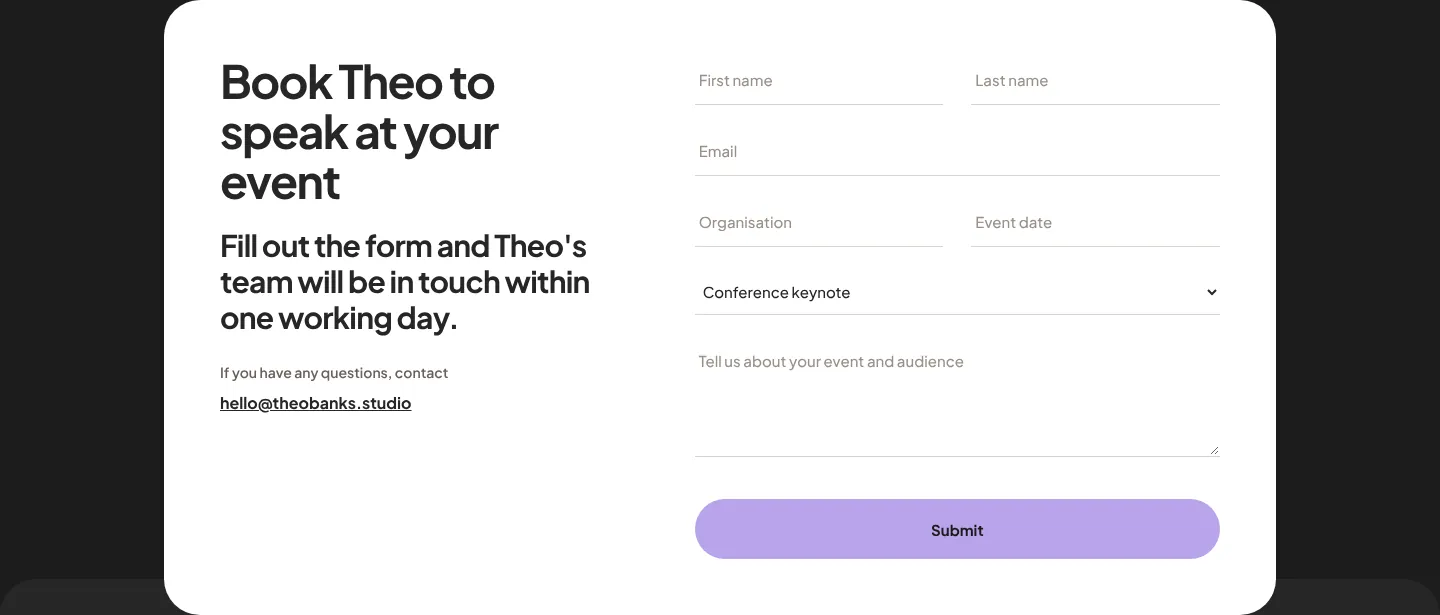
The booking card promises a reply within one working day and asks for name, email, organisation, event date, format and a message. It's short, clean and easy to finish.
How to copy it: ask only for what you need to reply with a quote and availability. Add a line on how quickly you reply, and make sure you keep that promise.
How to write creativity and innovation keynote topics
"Creativity" and "innovation" are among the hardest topics to sell, because they're so broad. The fix is specificity. Each topic should promise a concrete change for a specific audience.
| Vague topic | Specific topic |
|---|---|
| Unlocking creativity | The Brave Draft: Why the Best Ideas Look Wrong at First |
| Innovation mindset | From Idea to Pilot in 30 Days: Innovation Without the Theatre |
| Thinking outside the box | Better Briefs, Better Work: How Leaders Get More Creative Ideas from Their Teams |
| Creative leadership | Leading Creative People Without Killing the Spark |
| Embracing change | Small Bets: How Teams Test New Ideas Without Big Budgets |
| The future of creativity | Creativity with AI: What Changes, What Doesn't and What Teams Should Try Now |
The specific versions promise an outcome, hint at a method and tell planners who the talk is for. Several also give the audience something to repeat afterwards, which is how word of mouth starts.
A few more tips:
- Name your method. If your talk follows a process, give it a name. Our guide on presenting a leadership framework on one page shows how.
- Use one surprising word. "Brave", "wrong" and "theatre" make titles memorable without becoming jokes.
- Write the subtitle as the promise. The title gets attention; the subtitle tells planners what changes.
- Avoid clichés. "Think outside the box", "disrupt" and "game-changing" make you sound like everyone else.
Show the work, not just the words
Creativity and innovation speakers have an advantage most speakers don't: you can show your work. Use it.
Ideas for visual proof:
- Campaign or project images, with permission from clients
- Before and after examples from a workshop or a client project
- Photos from workshops, showing sticky notes, prototypes or people building something
- Your own creative work, such as illustrations, design, writing or products
- Short clips of exercises, showing an audience taking part
A single image of a team prototyping during your workshop says more about your approach than a paragraph about "hands-on, interactive sessions".
Keep the gallery tight. Six strong images beat thirty average ones, and every image should support a talk or a format on the page.
Design tips for creativity speaker websites
Your site should feel distinctive but still be easy to use. These principles keep both in balance:
- One accent colour. A single colour, used sparingly for highlights and buttons, looks more confident than a rainbow.
- Two fonts at most. A clean sans-serif for most text and a serif or display font for a few words of emphasis, as the Studio template does.
- Big, real photos. Stage, studio and workshop photos of you. Avoid stock images of lightbulbs and puzzle pieces.
- Plenty of space. White space makes your ideas easier to read and your work easier to see.
- Clear buttons. However creative the design, the "Book" button should never be hard to find.
- Fast on mobile. Many planners first see your site on a phone. Big images should still load quickly and text should be easy to read.
Creative doesn't mean complicated. The best creativity speaker websites are usually the simplest to use.
Free website vs other options for creativity speakers
| Option | Cost | Who builds it | Good for | Trade-offs |
|---|---|---|---|---|
| Portfolio site (Behance, personal portfolio) | Free to low | You | Showing creative work to clients | Not built for event planners: no talks, reel focus or booking form |
| DIY website builder | Monthly plan, plus your time | You | Full creative control | You write, design and maintain everything |
| Freelance designer | Hundreds to thousands upfront | A designer | A fully custom site | Cost, and updates often cost extra |
| Speakerfolio Free | $0 | Speakerfolio writes and builds it | A professional one-page speaker site | Speakerfolio address and a small footer credit |
| Speakerfolio Premium | $100 a year | Speakerfolio designs and builds it | Your own domain, custom design and more pages | Annual fee |
Many creative speakers keep a portfolio for clients and add a speaker site for planners, linking the two. For a closer look at the trade-offs, read our comparison of free vs paid keynote speaker websites.
How to get your free website
- Fill in the short form on the Speakerfolio site with your name, email and LinkedIn profile.
- Add your links: your portfolio, YouTube or Vimeo, social profiles and any video of you speaking.
- Choose a template. Studio is designed for creative speakers, or let us pick one for you.
- Review a private preview, usually within two working days.
- Go live. Once you approve it, your site is published on yourname.speakerfolio.com and your profile is added to the speaker directory.
To help us build the best site, send:
- Your best stage photos and a strong portrait
- Your speaker reel, or links to talk videos
- Your topics, even as rough notes
- Testimonials from organisers and clients
- Logos or names of brands and events you can mention
- A few images of your creative work, if they support your talks
Mistakes creativity speakers make with their websites
- Style over clarity. Unusual navigation or tiny text might look creative, but planners leave when they can't find your topics or booking form.
- Vague topics. "Innovation" isn't a talk. Give each topic a title and a promise.
- No reel. For a creativity speaker, how you come across on stage is a big part of the decision.
- Stock images. Lightbulbs and brain illustrations say the opposite of "original thinker".
- Too many projects. A portfolio dump buries your talks. Pick the work that supports what you speak about.
- Unnamed testimonials. Use the person's name, role and organisation, with permission.
- Out-of-date content. Old events and a stale "upcoming talks" list make you look inactive.
When to upgrade to Premium
The free site is a strong start. Premium suits creativity speakers who want a site that's entirely their own.
| Feature | Free | Premium |
|---|---|---|
| Web address | yourname.speakerfolio.com | Your own domain |
| Design | Speakerfolio template | Custom design in your own brand |
| Pages | One page | As many as you need, such as a page per talk, a portfolio or a blog |
| Admin access | Limited | Full |
| AI visibility | Basic setup | Full setup |
| Footer credit | Small Speakerfolio credit | No credit |
| Cost | $0 | $100 a year, with hosting and updates included |
Creative speakers often upgrade when they want their site to carry their own visual identity, or when they need extra pages for a portfolio, a book or workshop details. See Premium pricing for full details.
A quick checklist for your creativity speaker website
| Section | Have it? |
|---|---|
| Hero with a clear point of view and a booking button | |
| A two-minute reel near the top | |
| Brands, events or clients you can show | |
| About section with real creative work and four to six numbers | |
| Named testimonials from organisers | |
| Three or four specific keynote topics | |
| Formats: keynotes, workshops and more | |
| Visual proof of your work | |
| Book, podcast or press, if you have them | |
| Short booking form with a reply promise | |
| One accent colour, two fonts and fast mobile loading |
For more layouts across different speaker types, see our keynote speaker website examples, and for a full list of essentials, read what every speaker website needs.
How Speakerfolio helps creativity and innovation speakers
Speakerfolio gives creativity and innovation speakers a professional page that planners can find, check and contact.
- Free website: Speakerfolio writes and builds your one-page speaker site from your LinkedIn profile, on yourname.speakerfolio.com, usually within two working days. It includes your topics, reel, brands, testimonials and a booking form. The Studio template was designed for creative speakers.
- A profile in the Speakerfolio speaker directory, where planners search by topic and format.
- No commission: booking requests go straight to you.
- Premium ($100 a year): a custom design in your own brand on your own domain, with as many pages as you need.
Browse all the speaker website templates to compare layouts.
Frequently asked questions
Can creativity and innovation speakers really get a free website?
Yes. Speakerfolio builds a free one-page speaker site on yourname.speakerfolio.com, with no card and no trial period. The only condition is a small designer credit in the footer.
Which Speakerfolio template is best for creativity speakers?
Studio was designed for creative speakers, with a full-width reel, a logo section, expandable keynote topics, photo-led formats and a press section. Headliner is a good alternative if you have a book.
What should a creativity speaker website include?
A clear headline with a point of view, a reel, brands and events, an about section with real creative work, testimonials, specific keynote topics, formats, press and a booking form.
How do I make "innovation" a bookable topic?
Make it specific. Name the audience, the change and the method, such as "From Idea to Pilot in 30 Days: Innovation Without the Theatre", and add a subtitle with the promise.
Can I show my portfolio on the free site?
You can include a few images of your creative work that support your talks. A full portfolio with multiple pages suits Premium better.
How long does it take to get my site?
You usually receive a private preview within two working days. Once you approve it, your site goes live.
Will I get booking requests through Speakerfolio?
Booking requests from your site and directory profile go straight to you, with no commission. Speakerfolio can't promise a number of bookings, but a clear speaker page makes it easier for planners to say yes.
Get your free website as a creativity and innovation speaker
Creativity and innovation speakers are judged on their ideas and on how they present them. A focused speaker website, with a point of view, a reel, specific topics, real work and a simple booking form, shows planners both. Speakerfolio writes and builds it for you at no cost on the Studio template, and you can move to your own domain and brand with Premium whenever you're ready. Get your free speaker website today.

Saleh is a UI/UX and web designer with more than five years of experience and the founder of Speakerfolio, where he builds websites that help speakers get booked. He specialises in conversion-focused design and on-page SEO.
Connect on LinkedInRelated articles
All articles