Women in Leadership Speaker Website Examples: 12 Layouts That Get You Booked
Women in leadership speaker website examples: 12 layouts with screenshots for the hero, story, talks, results, testimonials and booking form, plus talk titles.
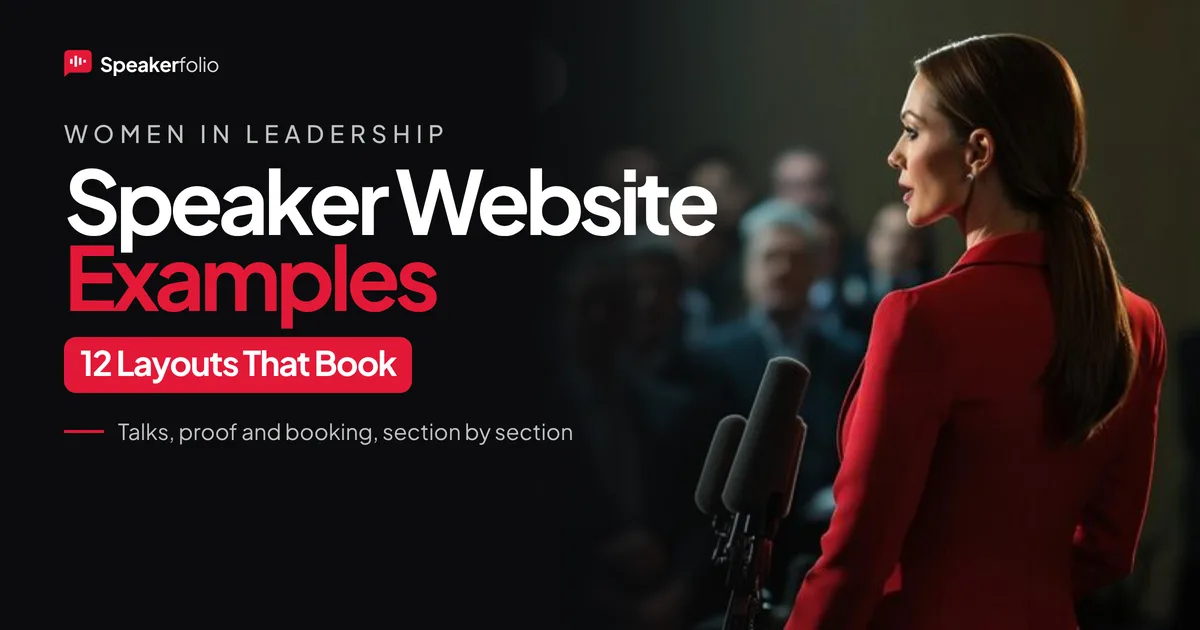
The best women in leadership speaker websites lead with a specific promise (who you help lead better, and how), not a general "inspiring women" message. They show signature talks with formats for conferences, company leadership programs and women's network events, back them with named testimonials and real results, and end with a booking form that asks for the event date, audience and format. Below are 12 women in leadership speaker website examples, section by section, built from the Speakerfolio Trainer template, with what each one does well and how to copy it. You'll also find talk title ideas, headline formulas, a checklist and the mistakes that keep good speakers booked only in March.
Key takeaways
- Lead with a leadership outcome, not only identity. "I help managers keep their best people through change" gets booked all year; "inspiring women leaders" often gets booked for one week.
- Speak to two audiences on one page: women's networks and employee resource groups, and the wider leadership programs, conferences and offsites that pay higher fees.
- Proof sells the booking. Named testimonials from HR and learning leaders, numbers from real programs and client stories do more than awards lists.
- Make the next step easy. A booking form with event date, audience size and format turns interest into enquiries.
Why women in leadership speakers need a strong website
Women in leadership remains a topic companies say they care about, and one where the evidence keeps showing a gap. The 2025 Women in the Workplace study by McKinsey and LeanIn.Org, covering 124 organisations and about 3 million employees, found that only about half of companies are prioritising women's career advancement. It also found that women at entry and senior levels still get less sponsorship than men, and that the ambition gap closes when women get the same career support. You can read the summary on the Women in the Workplace site.
That's the backdrop for every booking conversation you'll have. HR leaders, women's network chairs and conference planners need speakers who can turn that gap into practical change, and they need to see quickly that you're one of them.
Your website is where that decision happens. A planner will usually look at it before replying to your email, and often before they contact you at all. In a few minutes, they want to know:
- What you speak about, in words they can put in an agenda
- Who your talks are for: senior women, new managers, mixed leadership teams or the whole company
- What happens after the session, because budgets need results
- Who else has booked you, and what they said
- How to book you without a long email chain
The examples below show how to answer each of those, one section at a time.
Who books women in leadership speakers
Before you design anything, be clear about who you want to book you. Each buyer has a different reason, budget and timeline.
| Who books | Typical events | What they care about | Budget pattern |
|---|---|---|---|
| Women's networks and employee resource groups | International Women's Day, network launches, quarterly sessions | Energy, relevance, practical ideas for members | Often smaller, often tied to a date |
| HR and learning teams | Leadership programs, high-potential cohorts, manager training | Measurable change, follow-up, fit with their framework | Larger, planned months ahead |
| Conference organisers | Industry conferences, women in tech or finance events | A fresh angle, a strong stage presence, a clear title | Varies by event size |
| Professional associations | Annual meetings, chapter events, mentoring programs | Credibility in their field | Moderate, recurring |
| Universities and business schools | Women in leadership programs, alumni events, MBA electives | Expertise, research, a good story | Moderate, academic calendar |
| Executive teams | Offsites and leadership retreats | Senior credibility and facilitation skills | Higher, often bundled with workshops |
A single page can serve all of them, as long as it's clear what you offer and who it's for. The trick is to avoid writing only for the first row.
Example 1: A hero that names the leadership outcome
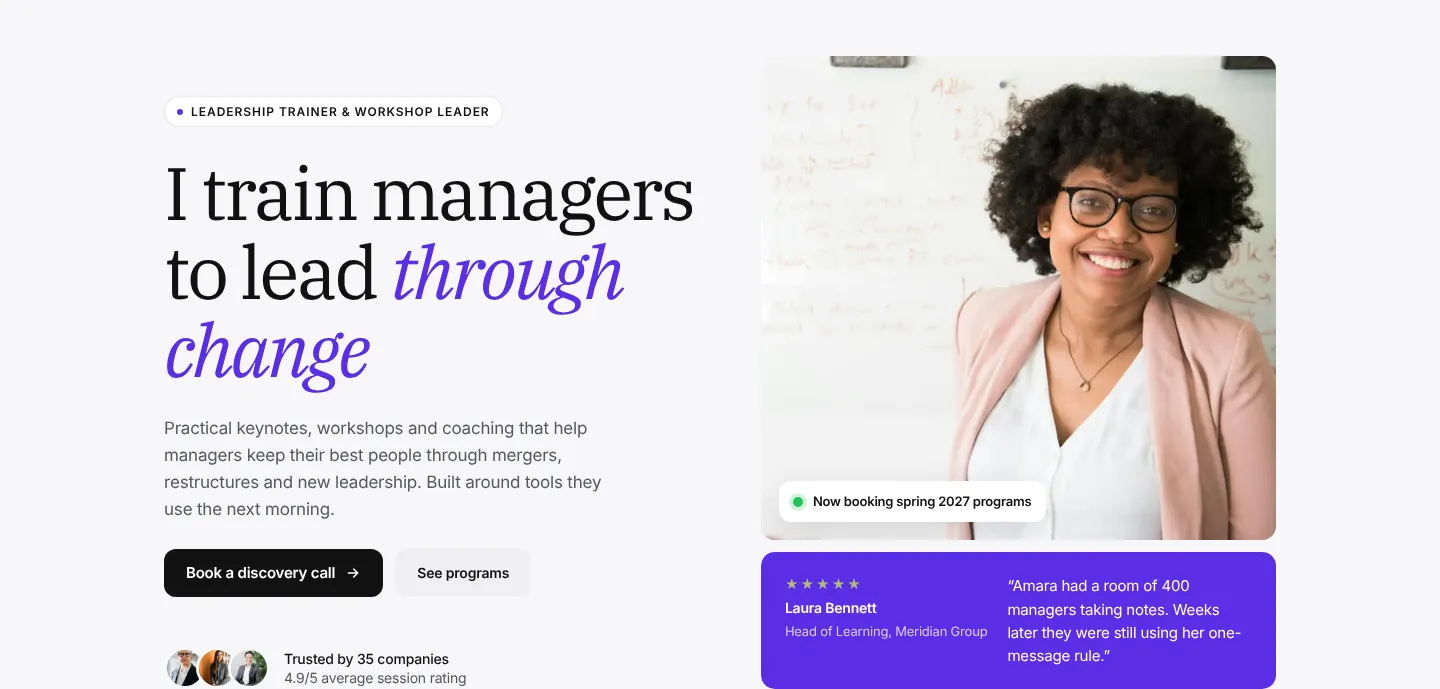
This hero, from the Speakerfolio Trainer template, belongs to a fictional leadership trainer, Amara Okafor. It does a lot in one screen:
- A clear role label. "Leadership trainer & workshop leader" tells planners straight away what kind of speaker this is.
- A specific promise. "I train managers to lead through change" names the audience and the result.
- A short supporting line. Practical keynotes, workshops and coaching that help managers keep their best people through mergers and restructures.
- Two buttons. "Book a discovery call" for buyers who are ready and "See programs" for those still comparing.
- Proof beside the buttons. A company count, an average session rating and a "Now booking" note.
- A testimonial card from a named head of learning, with a specific detail: a room of 400 managers taking notes.
Notice what the headline doesn't say. It doesn't say "empowering women" or "inspiring leaders". It says exactly who she helps and what changes. That makes her bookable for a mixed leadership program, a women's network session or a conference panel on change.
How to copy it: write your headline as "I help [audience] [result]". For example, "I help women in finance move into their first executive role" or "I help leadership teams build the confidence to speak up". Add one line on how you do it, then one piece of proof beside the button.
Headline formulas that work
| Weak | Stronger |
|---|---|
| Inspiring women to lead | I help women managers step into senior leadership with a clear plan |
| Keynote speaker and empowerment coach | Keynotes and workshops on confident decision-making for women in tech |
| Breaking barriers, building leaders | I help companies keep and promote their best women leaders |
| Women in leadership speaker | Practical leadership training for new managers, built for women's networks and leadership programs |
Example 2: An about section with a real turning point
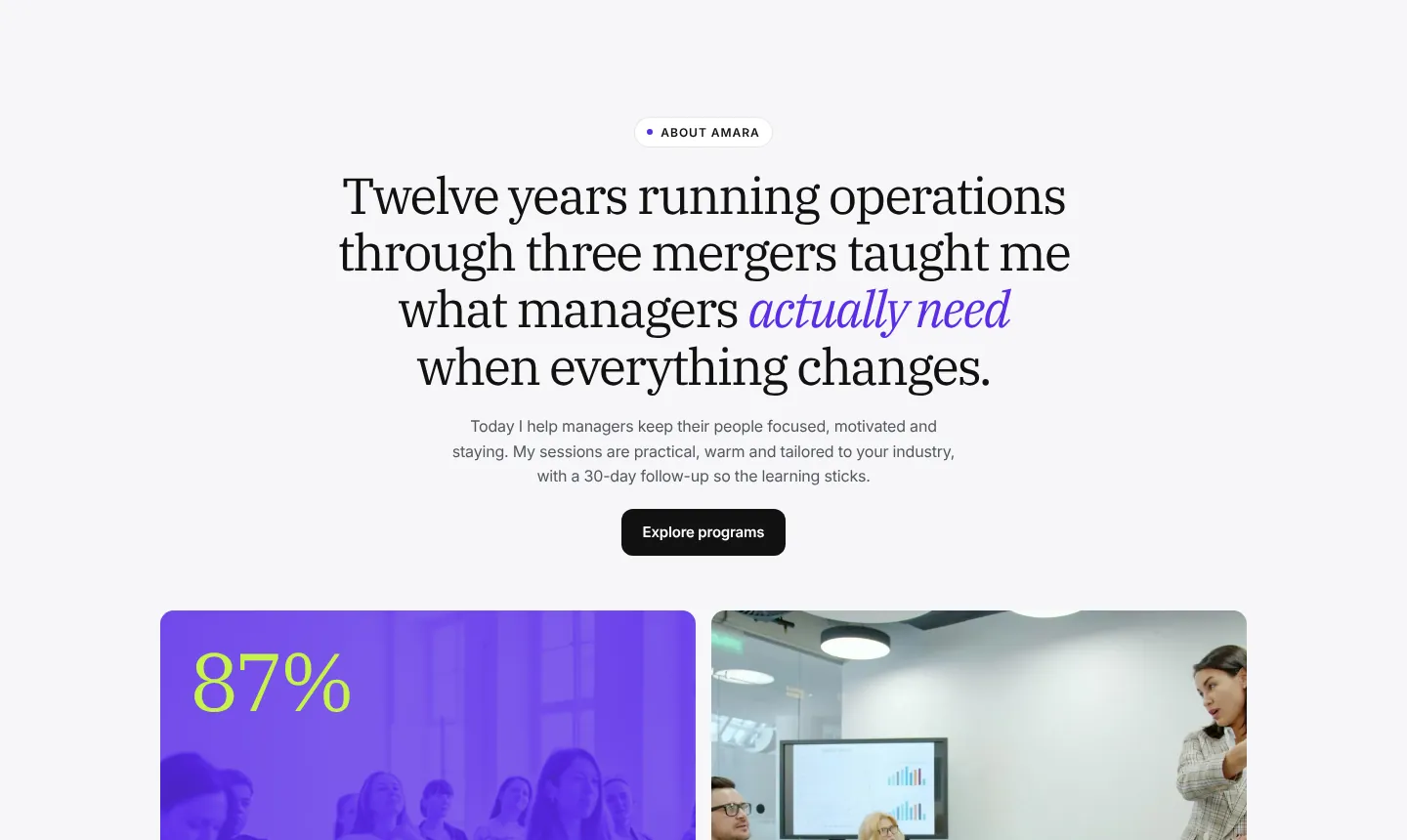
The about section starts with experience, not a title: "Twelve years running operations through three mergers taught me what managers actually need when everything changes."
Why this works for women in leadership speakers:
- It shows lived experience. Planners want to know you've led, not just studied leadership.
- It's short. One paragraph, then a button. The full career history can go in a downloadable bio.
- It brings in a number early. The card below shows that 87% of managers still use a tool from the session 30 days later. That's the kind of proof HR teams can repeat to their own leaders.
Many women leadership speakers have a powerful personal story: being the only woman in the room, a career setback, a return after a break or a move into a male-dominated field. Use it. But tie it to what the audience will learn, so the story serves the talk rather than replacing it.
How to copy it: open with one sentence about the experience that shaped your work. Follow with two or three sentences on how you help people now. Then add one number from your own work. Our guide on how to write a speaker bio planners can actually use has templates.
Example 3: A story timeline for a career with turns
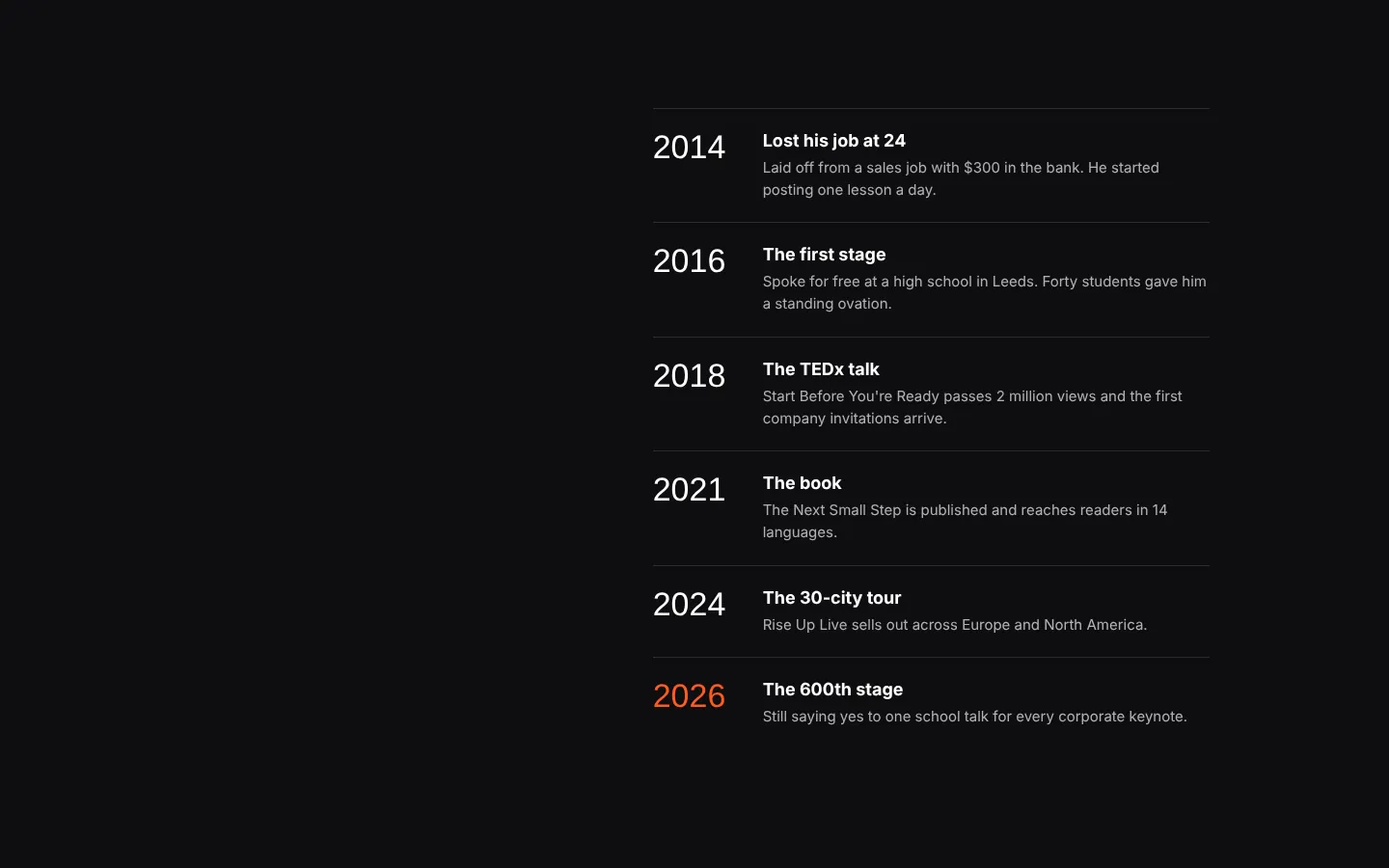
This timeline comes from the Speakerfolio Ignite template. Each milestone has a year, a short title and one sentence. It turns a career story into something a planner can scan in ten seconds.
For a women in leadership speaker, a timeline might show:
- The first leadership role, and what was hard about it
- A turning point: a promotion, a setback or a career change
- The moment you started training or coaching others
- A book, a TEDx talk or a major client
- Where you are now
How to copy it: pick four to six moments that explain why you're credible on your topic. Keep each one to a single sentence. If your story includes something personal you're not comfortable sharing on stage, leave it out here too. The timeline should match the story you tell in your talks.
Example 4: Talks and programs with formats
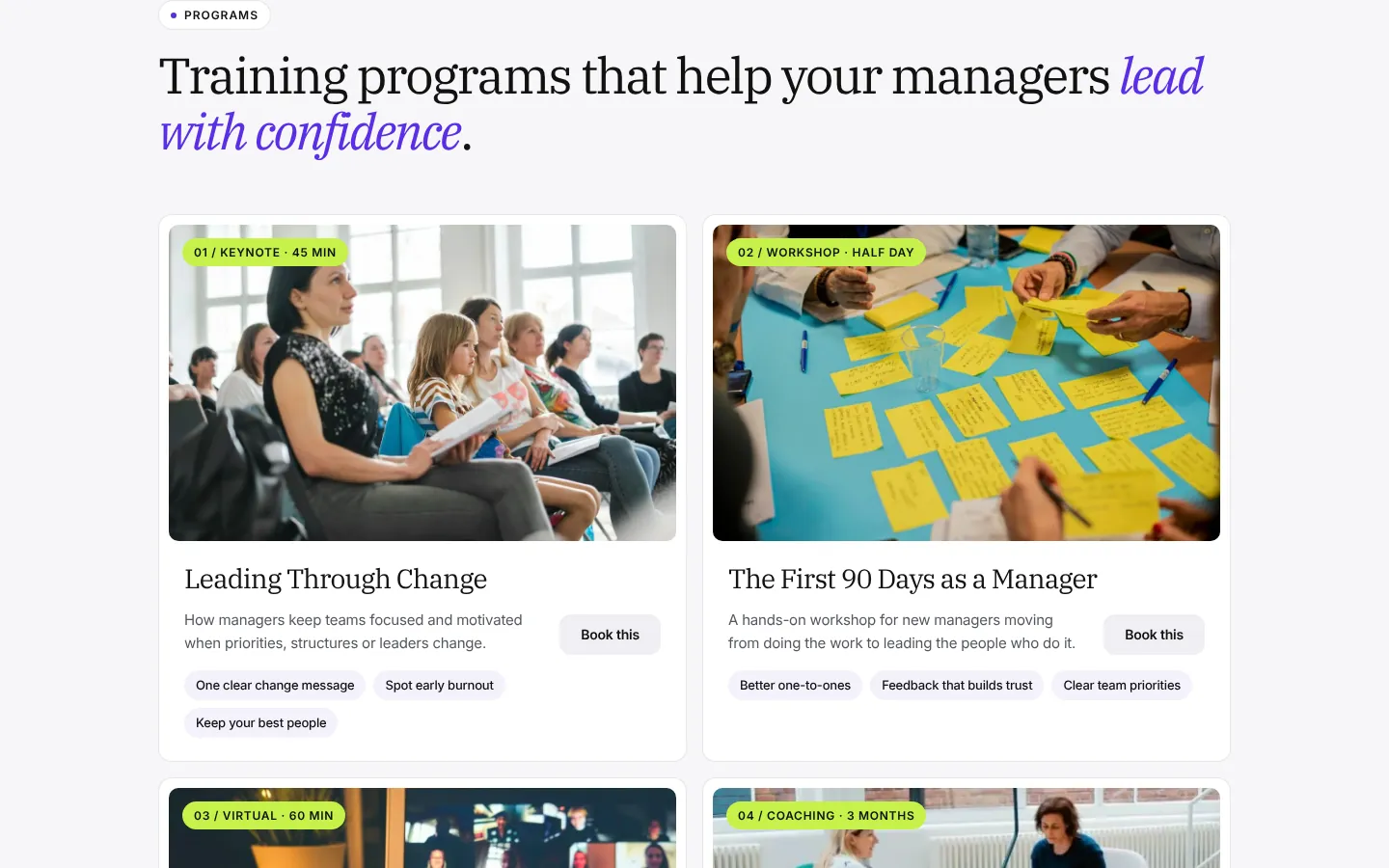
This is the section planners spend the most time on. The Trainer template lists four programs, each with:
- A number and format label, such as "01 / Keynote · 45 min" or "02 / Workshop · Half day"
- A clear title, such as "Leading Through Change" or "The First 90 Days as a Manager"
- One sentence on who it's for and what it covers
- Three outcomes, like "One clear change message" or "Feedback that builds trust"
- A "Book this" link next to each one
That mix of formats matters. A keynote suits a conference or International Women's Day event. A half-day workshop fits a leadership program. A virtual session works for global networks. A coaching program turns a one-off booking into an ongoing engagement.
How to copy it: list three or four offers with different formats. Give each one a title that promises a result, one sentence and three outcomes. Include at least one offer that works for a mixed audience, not just women.
Women in leadership talk title ideas
These examples are for illustration. Use them as a starting point for your own.
| Talk title | Best format | Best audience |
|---|---|---|
| From Expert to Executive: Making the Leap to Senior Leadership | Keynote | High-potential women, leadership programs |
| Speak Up, Be Heard: Confident Communication in High-Stakes Rooms | Workshop | Women's networks, new managers |
| The Sponsor Effect: How to Find Advocates, and Be One | Keynote | Mixed leadership teams, ERGs |
| Leading Through Change Without Burning Out | Keynote or workshop | Managers in any industry |
| Building Teams Where Everyone Gets Heard | Workshop | Leadership teams, HR |
| Your Next Role: A Practical Promotion Plan | Workshop | Mid-career women, mentoring programs |
| The First 90 Days in a Leadership Role | Half-day workshop | New managers and newly promoted leaders |
| Negotiating Your Worth | Workshop or virtual | Women's networks, associations |
Titles like "The Sponsor Effect" work because they speak to the whole room. Women learn how to find advocates; senior leaders learn how to become one. That makes the talk easier to sell to an HR team as well as a women's network.
If your talks are built on a named method, see our guide to presenting a leadership framework on one page.
Example 5: How you work, step by step
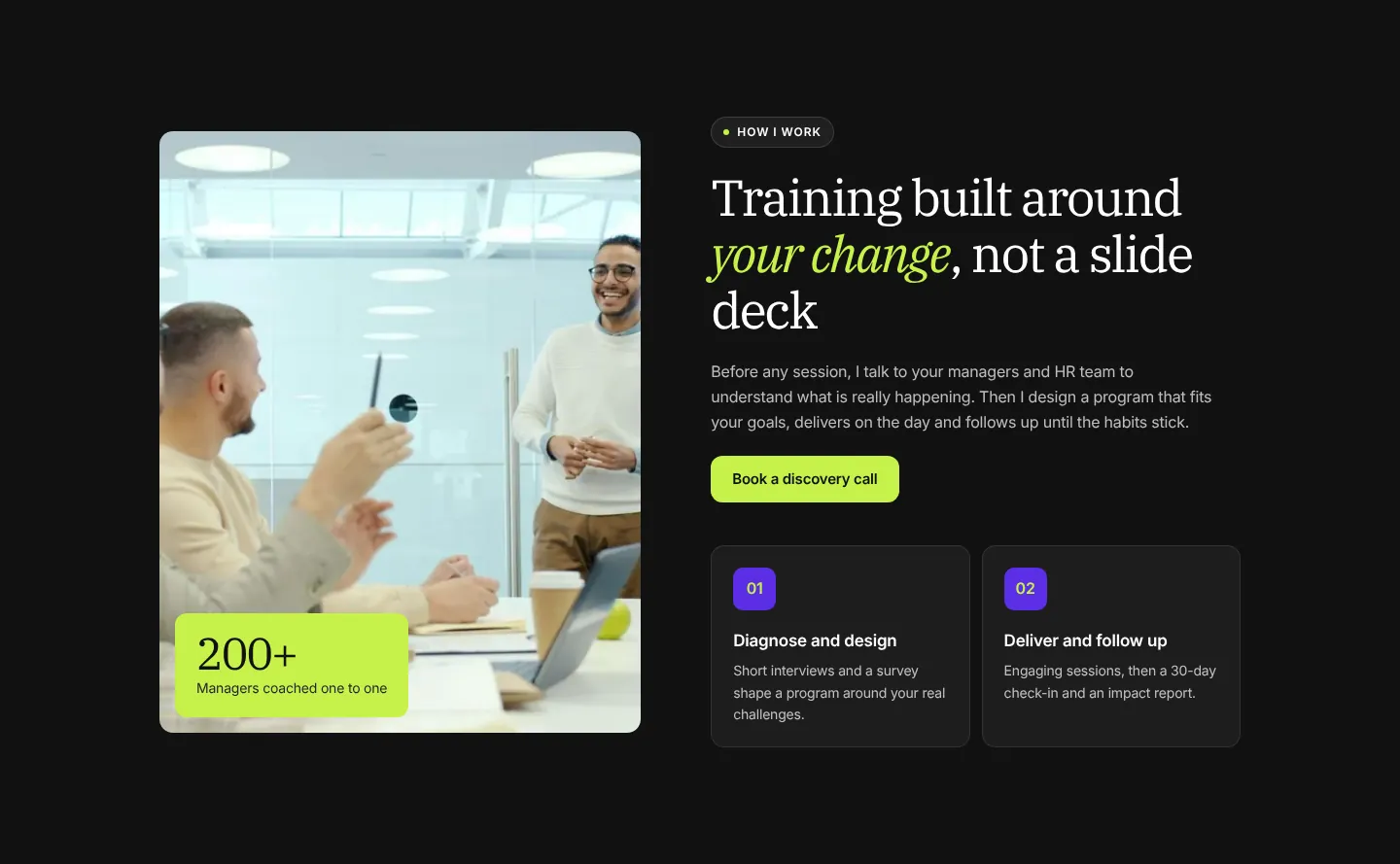
HR and learning teams are often booking more than a talk. They want to know how you'll tailor it and what happens afterwards.
This section answers that in two steps:
- Diagnose and design. Short interviews and a survey shape the program around the client's real challenges.
- Deliver and follow up. Engaging sessions, then a 30-day check-in and an impact report.
A short heading sums up the promise: "Training built around your change, not a slide deck."
How to copy it: describe your process in two to four steps, from the first call to follow-up. If you run a pre-event survey, interview a few attendees or send a summary afterwards, say so. Those details are often what wins a leadership program over a one-off talk.
Example 6: Client stories, not just logos
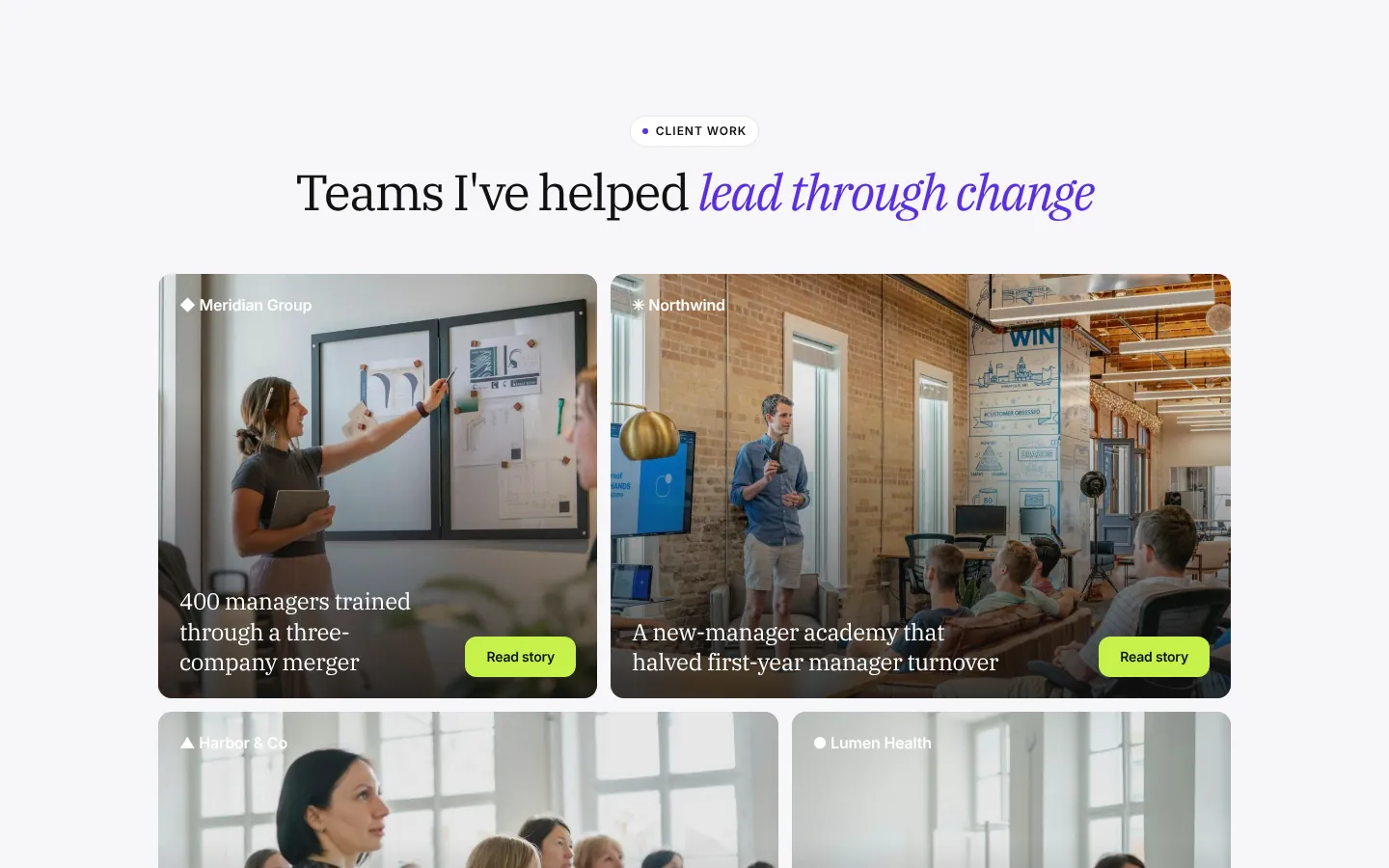
A row of logos shows who booked you. A short client story shows what changed. This section has four stories, each with a company name, a one-line result such as "A new-manager academy that halved first-year manager turnover" and a link to read more.
For women in leadership speakers, strong stories might be:
- A women's leadership program where participants went on to promotions
- A mentoring scheme you designed or launched
- A company where you trained managers to sponsor women on their teams
- A women's network that grew after your session
How to copy it: write three or four one-line results. Only use client names and figures you have permission to share. If you can't name a client, describe the organisation instead: "a 2,000-person logistics company" is still useful.
Example 7: Results with numbers that HR can reuse
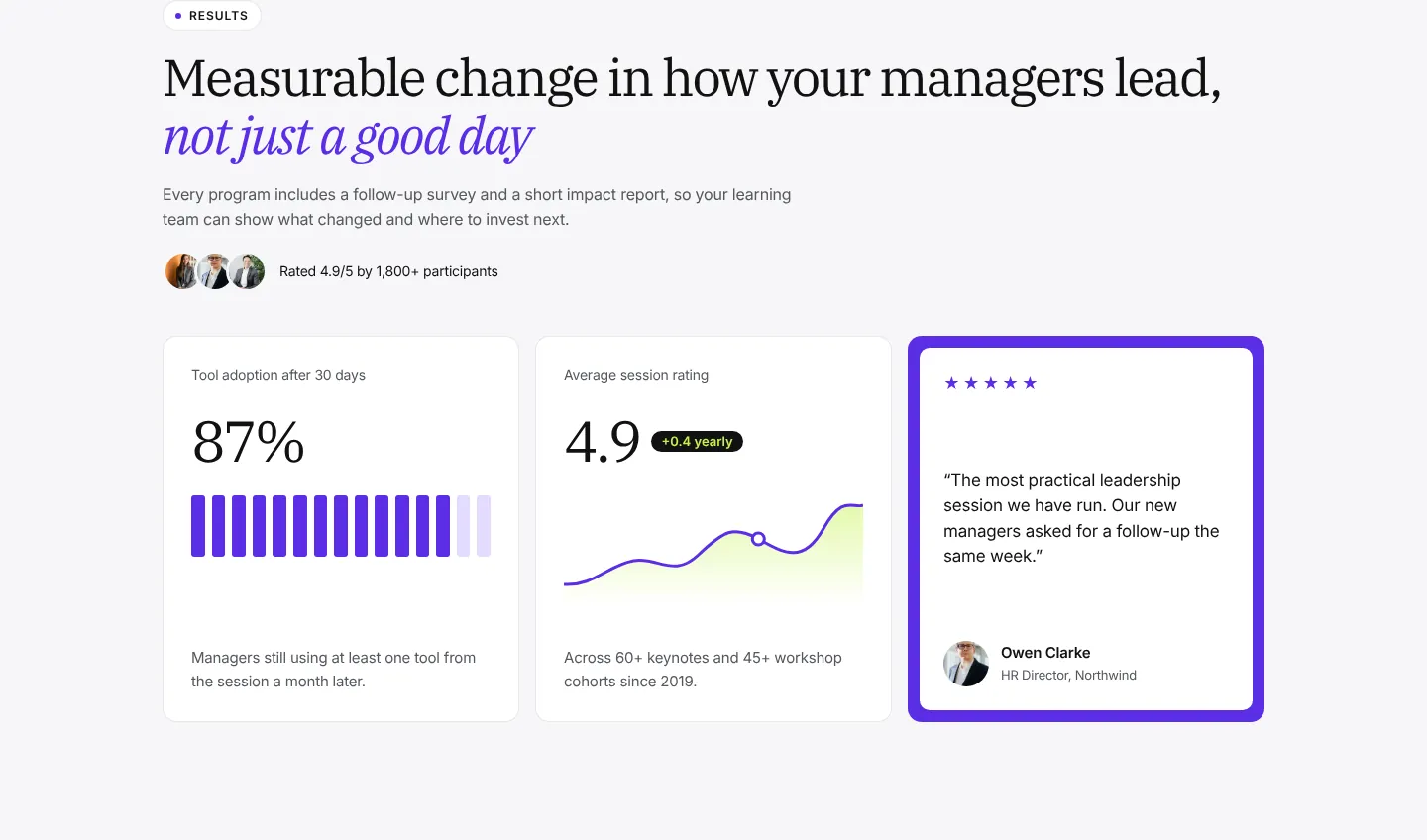
This results section turns impact into numbers: a tool adoption rate 30 days after the session, an average session rating and how many keynotes and workshops it's based on. A short testimonial from a named HR director sits alongside.
Why this matters: the person booking you usually has to justify the spend. Numbers they can copy into a proposal or a report make that easy.
Useful numbers for women in leadership speakers include:
- How many leaders you've trained or coached
- Participant ratings from post-session surveys
- Promotions or role changes among program participants, where clients share them
- Retention or engagement results from client programs
How to copy it: pick two or three numbers you can stand behind and explain where they come from. "4.9/5 average rating from post-session surveys" is more convincing than "rated outstanding".
Example 8: Testimonials from the people who book
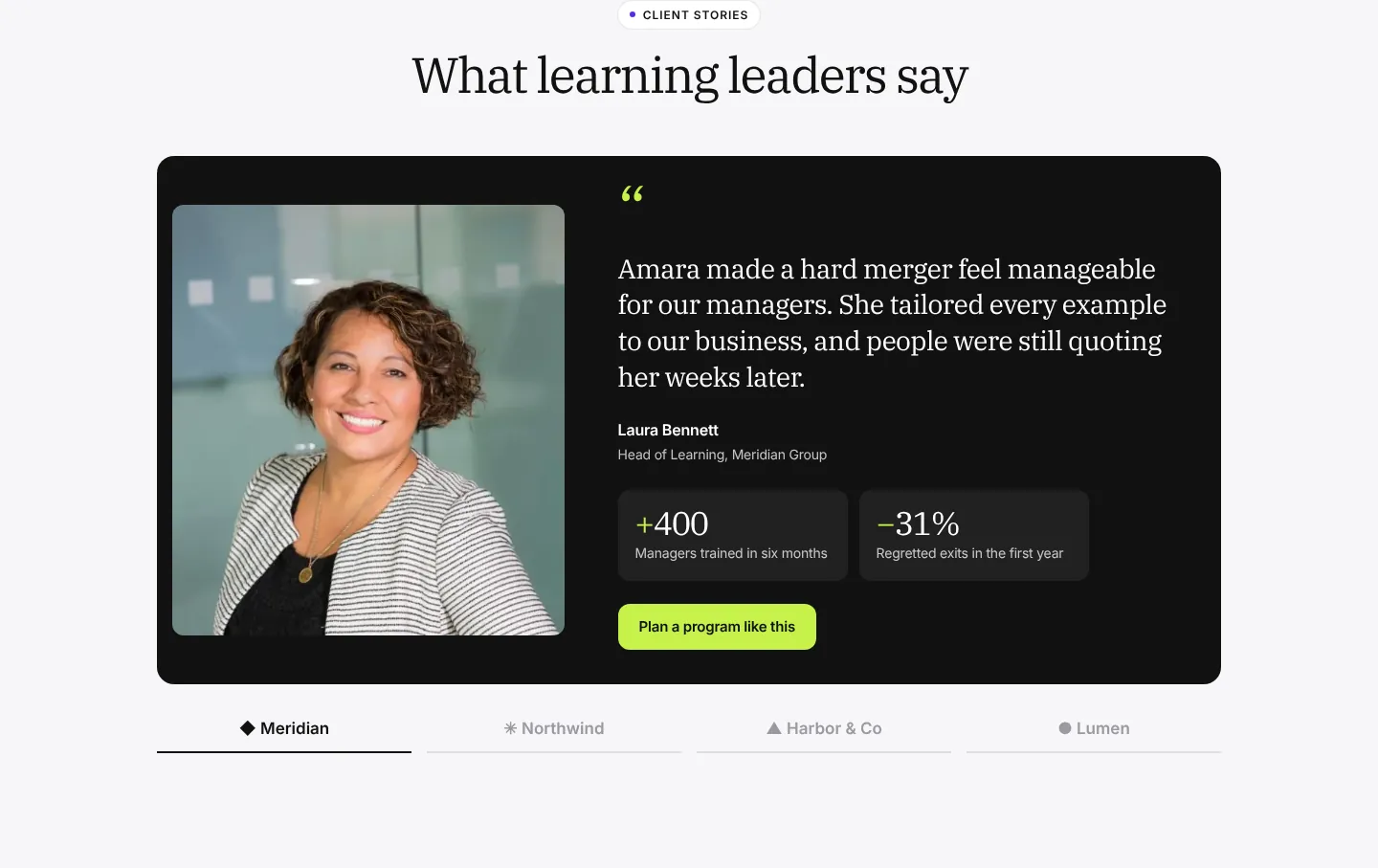
This testimonial section puts one quote front and centre, with the person's name, role, company and photo. Beside it are two results from the same engagement and a button to plan a similar program.
What makes it effective:
- The quote is specific. It mentions tailoring examples to the business and people quoting the speaker weeks later.
- It's from a buyer. A head of learning is exactly the kind of person who books speakers.
- It links to action. "Plan a program like this" turns proof into a next step.
How to copy it: collect testimonials from organisers, HR leaders and network chairs, not only from attendees. Ask straight after the event, when the impact is fresh. Our guide on how to ask for testimonials has wording you can use.
Example 9: A book section, if you've written one
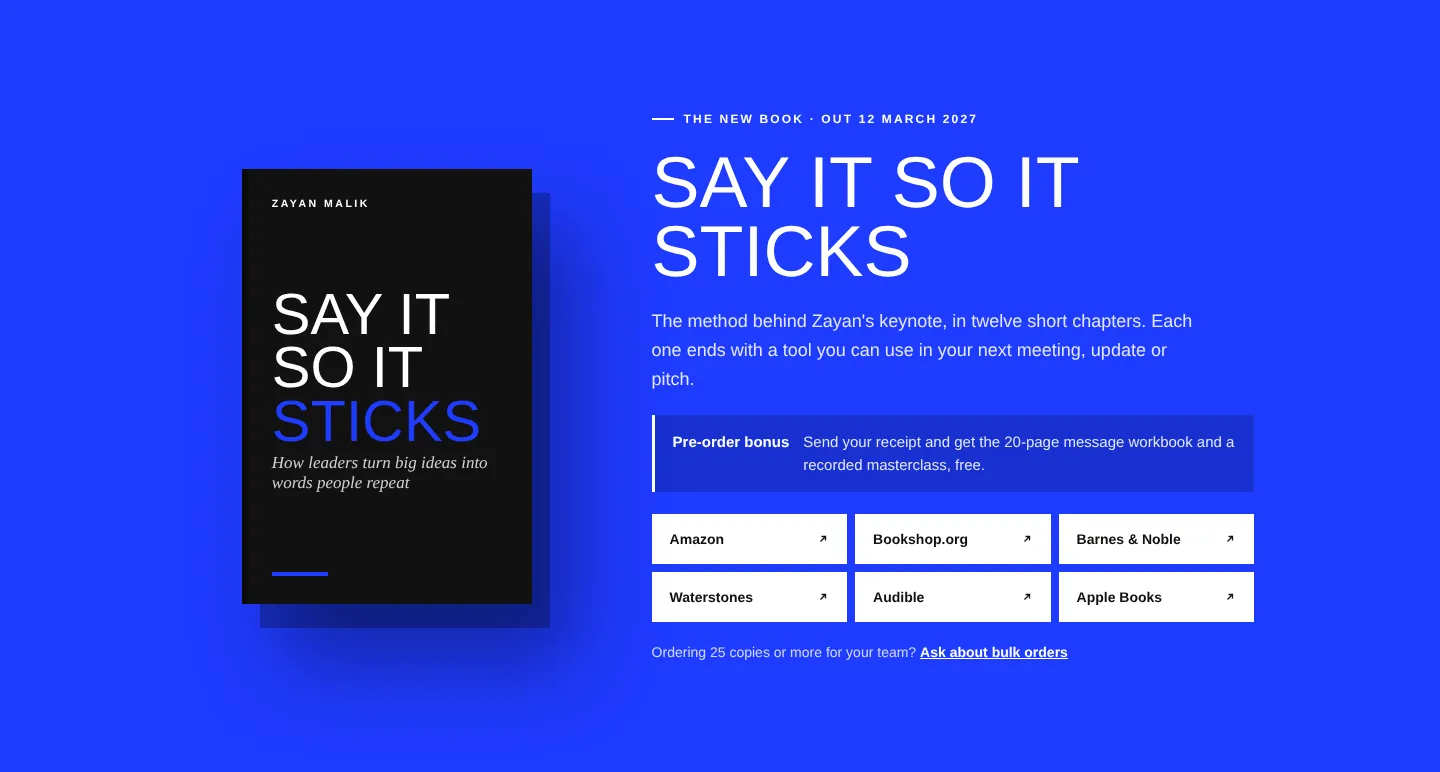
Many women in leadership speakers have written a book, and it's often the strongest credential they have. This section, from the Speakerfolio Headliner template, shows the cover, the release date, a short description of the method behind the keynote, a pre-order bonus, buttons for six bookstores and a link for bulk orders.
Books help in two ways. They give planners a clear reason to trust your expertise, and they open up book-talk bookings, bulk orders and signing sessions.
How to copy it: show the cover, one or two sentences on who the book is for and what readers learn, links to buy it and a line for bulk orders, then connect it to the talk based on it. If you don't have a book, use this space for a guide, a research report or a podcast.
Example 10: Insights that show your thinking
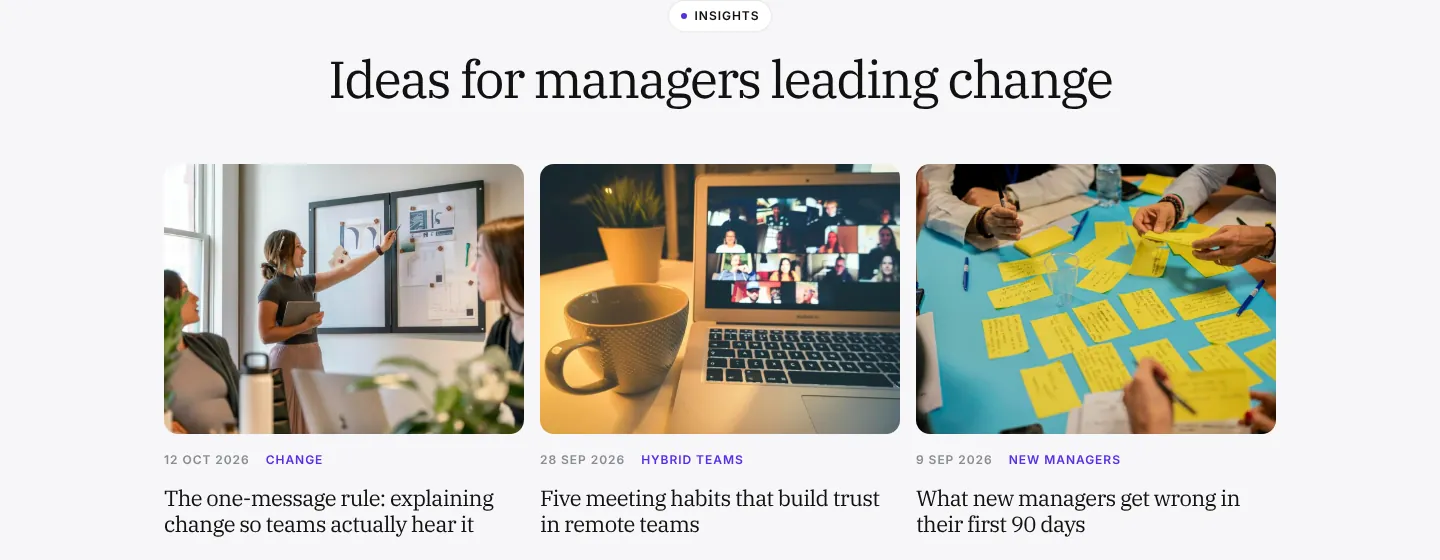
Three short articles, each with a date, a category and a clear title. This section shows planners how you think and gives search engines more reasons to find your site.
For women in leadership, titles might include "Three questions to ask before you accept a promotion", "How managers can sponsor women on their teams" or "What I learned as the only woman on an executive team".
How to copy it: write one useful article a month on the questions your audience asks. Keep the titles practical. Even three good articles make your site look active and current.
Example 11: FAQ for planners
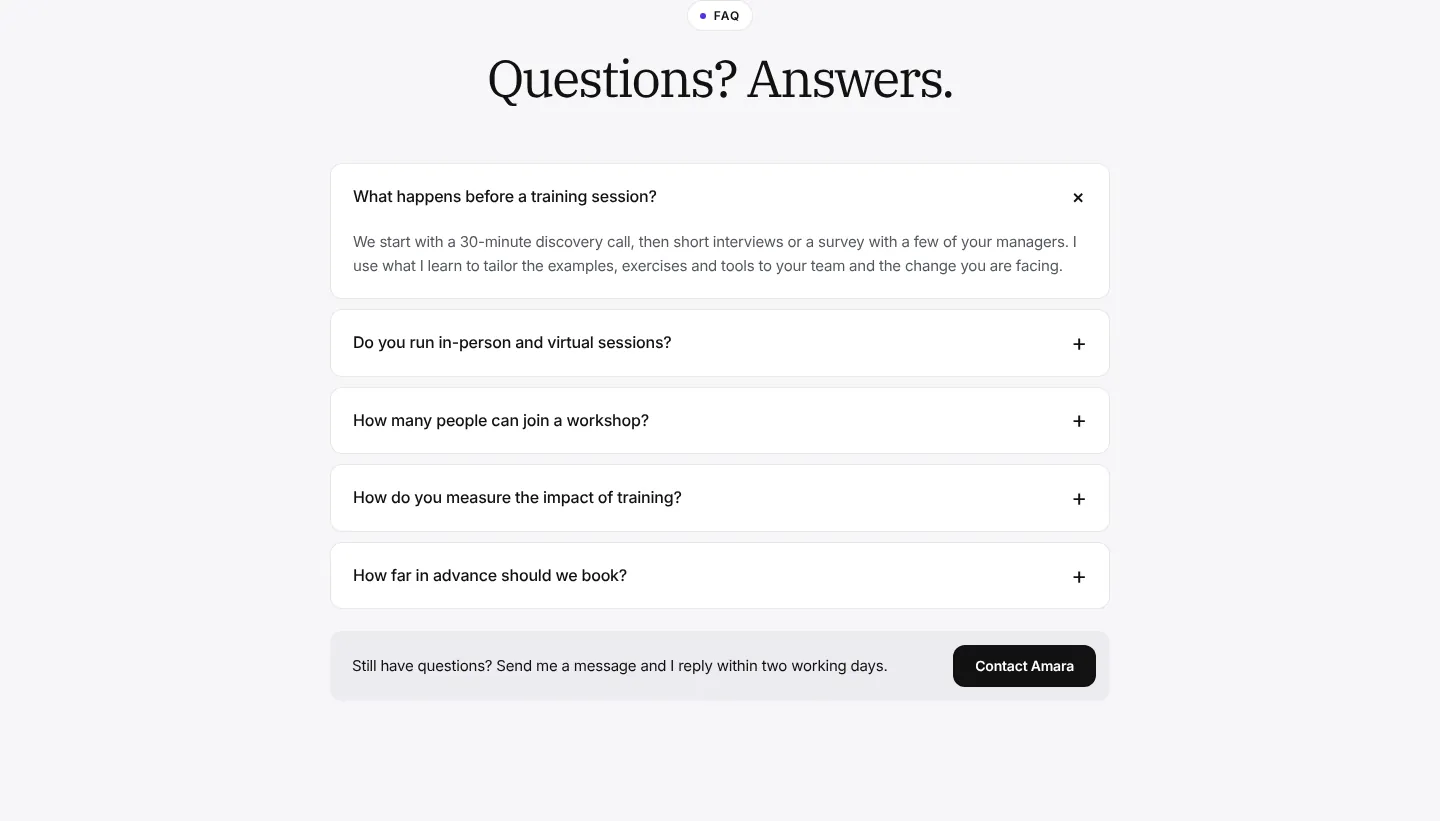
The FAQ answers the questions planners usually email about: what happens before a session, whether you work in person and online, how many people can join, how you measure impact and how far ahead to book.
For women in leadership speakers, add questions such as:
- Is the talk suitable for a mixed audience? Many companies want sessions that include men as allies and sponsors.
- Can you tailor it for International Women's Day? Say how far ahead people should book, since March fills up early.
- Do you offer panels or fireside chats? Networks often want a conversation format.
- Can the session be recorded for internal use? Say whether that's included or costs extra.
Example 12: A booking form that asks the right questions
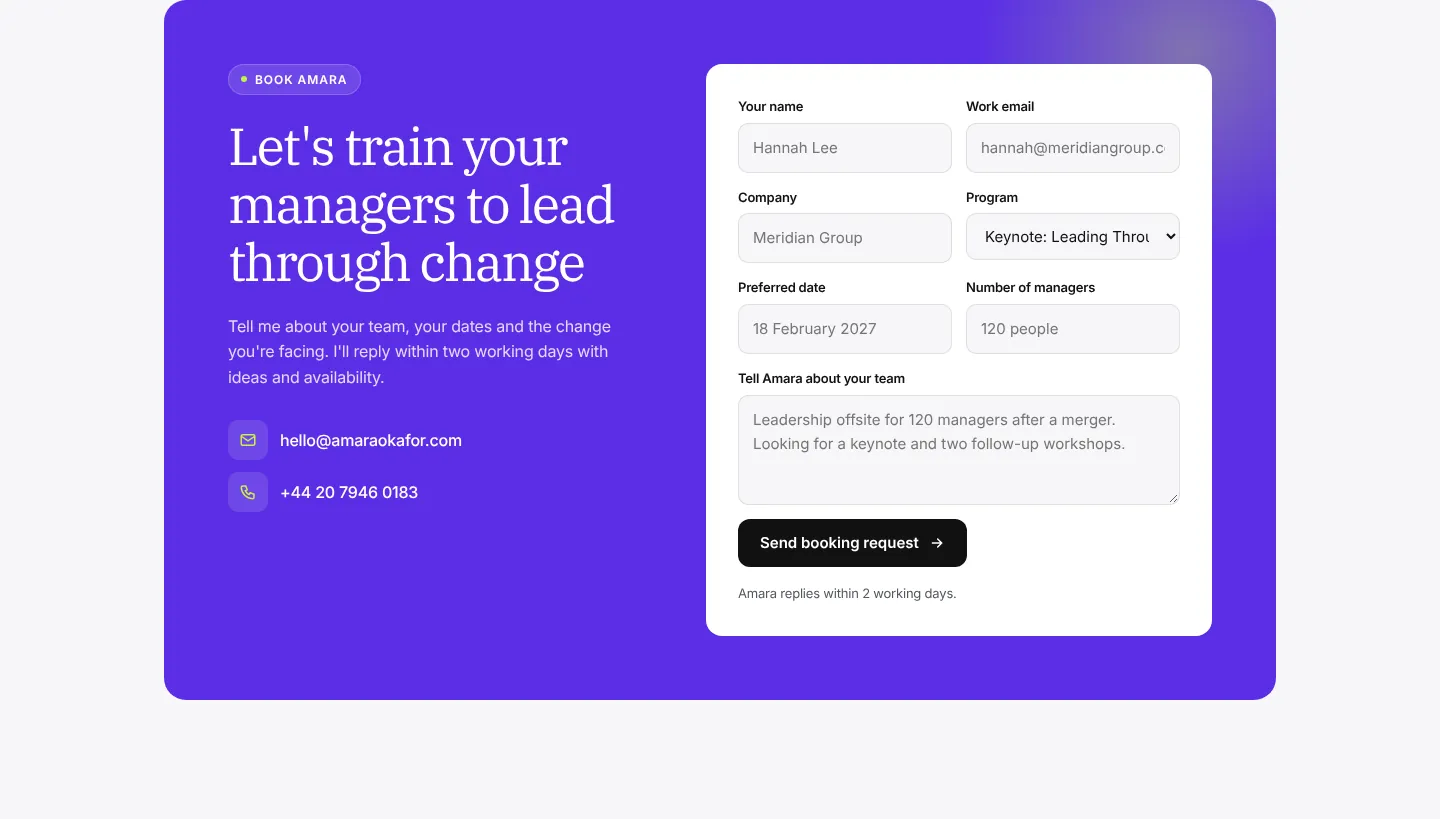
The final section invites the planner to tell the speaker about their team, dates and goals, and promises a reply within two working days. The form asks for name, work email, company, program, preferred date, number of managers and a message.
Those fields give you enough to reply with ideas and availability straight away, which speeds up every booking.
How to copy it: keep the form short but specific. Ask for event date, location or virtual, audience size and who they are, preferred format and a message. Add a line on how quickly you reply.
Beyond International Women's Day: how to get booked all year
Many women in leadership speakers find their calendar fills up in March and empties out for the rest of the year. Your website can change that.
- Lead with leadership, not only gender. Talks on confidence, sponsorship, promotion, change and communication fit leadership programs year-round.
- Show mixed-audience formats. Make it clear your sessions work for whole leadership teams, not only women's networks.
- Add programs, not just talks. A three-month cohort for high-potential women is booked by HR budgets, which run all year.
- Publish the calendar hooks. Mention mentoring program launches, promotion cycles, new manager intakes and annual leadership conferences, so planners think of you for those dates too.
- Say when to book for March. A short note such as "International Women's Day sessions book up early; enquire by January" helps you fill the busiest week and frees up the rest of your year.
Photos that work for women in leadership speakers
Your photos say as much as your copy. Aim for a small set that covers three needs:
| Photo | Why it matters | Where it goes |
|---|---|---|
| A clear, recent headshot | Planners use it in programs and event pages | Hero, bio, one-sheet |
| You on stage or leading a session | Shows you in front of a real audience | Hero or about section |
| You working with a small group | Shows you can facilitate, not just present | Programs or process section |
| A wide shot with the audience | Shows the scale of rooms you work in | Results or client stories |
Use real event photos wherever you can. If you're just starting out, ask a friend to photograph you running a workshop or speaking at a local network meeting. A clear, well-lit phone photo of a real session beats a stock image every time.
Common mistakes on women in leadership speaker websites
- A generic headline. "Empowering women to lead" could belong to anyone. Name your audience and result.
- Only one audience. If every line speaks only to women's networks, HR teams and conference planners may not see themselves in your offer.
- Awards before outcomes. Awards are nice; planners care more about what changed for clients.
- Anonymous testimonials. "Fantastic speaker! – HR Manager" won't convince anyone. Use names and roles, with permission.
- No video. A short clip of you speaking is one of the strongest pieces of proof you can offer.
- No formats or prices. Planners need to know whether you offer keynotes, workshops or programs, and roughly what to budget.
- A hidden booking form. Put a button in the hero and the form at the bottom.
A quick checklist for your website
| Section | Have it? |
|---|---|
| Hero with a specific promise, a booking button and one piece of proof | |
| About section with a real turning point and one number | |
| Talks or programs with titles, formats and outcomes | |
| At least one offer for mixed audiences | |
| How you work, from first call to follow-up | |
| Client stories with one-line results | |
| Results with numbers you can explain | |
| Named testimonials from people who book speakers | |
| A short video of you speaking | |
| Book, guide or insights, if you have them | |
| FAQ for planners, including International Women's Day timing | |
| Booking form with date, audience, format and message |
You can see more layouts in our keynote speaker website examples, and if you coach as well, our coach website examples cover discovery calls and programs.
How Speakerfolio helps women in leadership speakers
Speakerfolio builds speakers a professional page that planners can find, check and contact.
- Free website: Speakerfolio writes and builds your one-page speaker site from your LinkedIn profile, on yourname.speakerfolio.com, usually within two working days. It includes your talks and programs, testimonials, bio, video and a booking form. The Trainer template shown in this article suits leadership speakers who also run workshops and programs.
- A profile in the Speakerfolio speaker directory, where planners search by topic and format, including leadership.
- A speaker one-sheet you can send to planners. Our guide shows how to create a speaker one-sheet if you want to build your own.
- No commission: booking requests go straight to you.
- Premium ($100 a year): a custom design on your own domain, with as many pages as you need, such as a page per program, a media kit or a blog.
Browse all the speaker website templates to compare layouts.
Frequently asked questions
What should a women in leadership speaker website include?
A clear headline about the leadership result you help people get, an about section, talks or programs with formats, client stories, results, named testimonials, a short video, an FAQ and a booking form. A book or insights section helps if you have one.
How do I make my website stand out as a women in leadership speaker?
Be specific. Name your audience and the change you create, show proof from real clients and include at least one offer for mixed leadership audiences. Specific beats inspirational.
Should my website only target women's networks?
No. Women's networks are an important audience, but HR teams, leadership programs and conferences often have larger budgets and book all year. Write for both.
How do I get booked outside International Women's Day?
Lead with leadership topics that fit year-round programs, offer workshops and cohorts as well as keynotes, and mention other calendar moments such as promotion cycles and new manager intakes.
Do I need a video on my speaker website?
It's strongly recommended. A two-minute clip of you speaking helps planners judge your style and stage presence. If you don't have stage footage yet, record a short talk on your topic.
Should I show my speaking fees?
Showing a "from" price or explaining how your fees work saves time for both sides. If you prefer not to, say that fees depend on format and audience and invite planners to enquire.
Can I get a women in leadership speaker website for free?
Yes. Speakerfolio builds a free one-page speaker site on yourname.speakerfolio.com with your talks, testimonials, video and a booking form, and lists you in the speaker directory. Premium adds your own domain and more pages for $100 a year.
Conclusion
The strongest women in leadership speaker website examples share a few habits: a specific promise in the headline, a real story tied to what the audience will learn, talks and programs with clear formats, proof from the people who book speakers and a booking form that makes the next step easy. Build those sections, write for both women's networks and the wider leadership audience, and your site will work for you all year, not just in March. Get your free speaker website from Speakerfolio to start.
Saleh is a UI/UX and web designer with more than five years of experience and the founder of Speakerfolio, where he builds websites that help speakers get booked. He specialises in conversion-focused design and on-page SEO.
Connect on LinkedInRelated articles
All articles