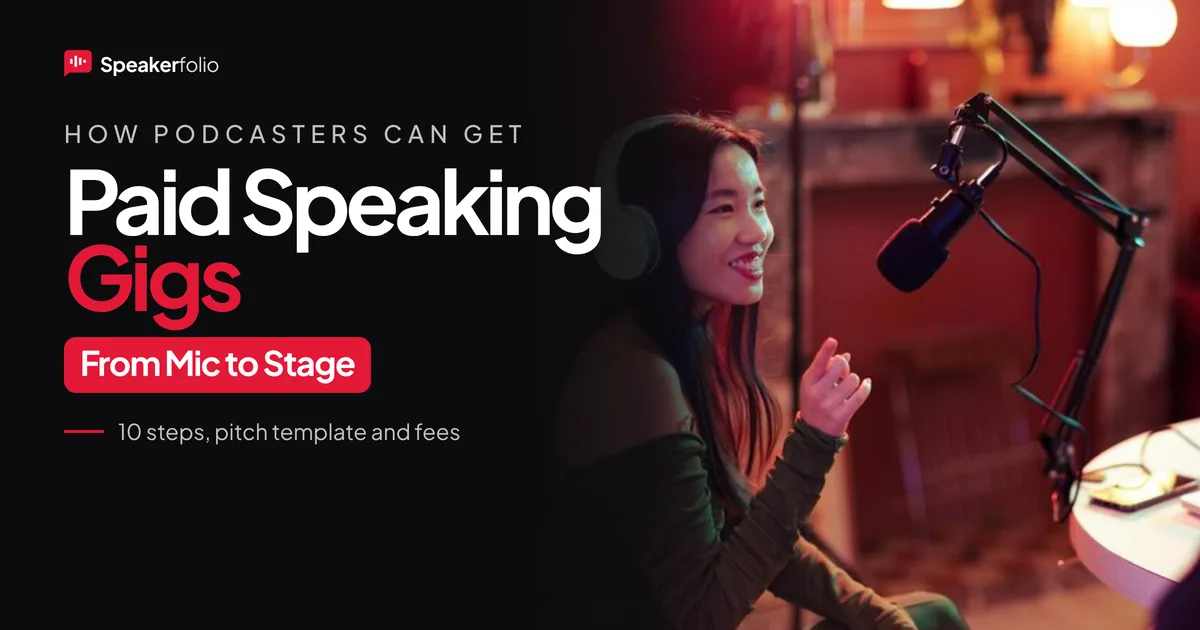
How Podcasters Can Get Paid Speaking Gigs: 10 Steps from Mic to Stage
How podcasters can get paid speaking gigs: turn episodes into a signature talk, cut a reel, build a speaker page, find paying events, pitch and set fees.
Podcasters can get paid speaking gigs by turning their show into proof: pick one topic your best episodes keep returning to, build a signature talk from those episodes, cut a short speaker reel from your video footage, and put it all on a speaker page with clear talk titles and a booking form. Then pitch the events your listeners and guests already attend, such as industry conferences, associations and company events, starting with your own network. Most podcasters begin with a few free or low-fee talks, and emerging speakers commonly charge about $1,500 to $5,000 per talk once they have proof. Below are 10 steps, a pitch template, fee guidance and a 90-day plan.
Key takeaways
- Your podcast is already a speaker portfolio. Episodes show your ideas, your voice and how you handle conversation, which is exactly what event planners want to see.
- Speak on your show's topic, not on podcasting. Unless you serve podcasters, the paid gigs are in your niche's industry events.
- Your guests are your best leads. Many of them run, sponsor or speak at the events you want to be booked for.
- Make it easy to book you. A speaker page with talks, a reel and a booking form turns interest into enquiries.
Why podcasters make strong speakers
Podcasting and speaking are closer than they look. Both are about holding attention with your voice, explaining ideas clearly and keeping people listening to the end.
The audience is there, too. Edison Research's Infinite Dial 2026 found that a record 80% of Americans aged 12 and over have listened to or watched a podcast, as reported by Tubefilter. Many of the people booking speakers for conferences and company events listen to podcasts in their own field.
Here's how what you already have maps to what event planners look for:
| What you have as a podcaster | What it proves to an event planner |
|---|---|
| A back catalogue of episodes | You have plenty to say on your topic |
| Video episodes or clips | How you look and sound, before they book you |
| A guest list of respected names | You're connected and trusted in your industry |
| Listener reviews and messages | People value your ideas |
| A loyal audience | You can promote the event and help fill seats |
| Practice interviewing and moderating | You can run panels, fireside chats and Q&A |
That last row matters more than many podcasters realise. Moderating a panel or hosting a fireside chat is a natural first paid booking for a podcast host.
Step 1: Choose the topic you'll speak on
Your show might cover a lot of ground. Your talks need a focus.
Look back over your episodes and ask:
- Which episodes got the most listens, shares or messages?
- What do listeners ask you about most?
- Which ideas do you keep coming back to, whoever the guest is?
The answer is usually your speaking topic. A podcast about running a small agency might lead to a talk on pricing creative work. A show about nursing could lead to a talk on burnout and retention for hospital leaders.
A common mistake is to speak about podcasting itself. That works if your listeners are creators or marketers. For everyone else, event planners book you for what your show is about, not for the fact that you host one.
Step 2: Turn your best episodes into a signature talk
You've probably already said the core of your talk out loud, many times, on your show. Now shape it into 30 to 45 minutes with a clear arc.
A simple structure that works:
- Open with a story from your show: a guest's turning point, or the episode that changed how you think.
- Name the problem your audience faces, in their words.
- Share three ideas or steps, each backed by a story or quote from an episode.
- Give one practical takeaway people can use the next day.
- Close with a call to action, such as a free resource or an invitation to listen to the show.
Name the talk after the outcome, not the show. "Three Pricing Mistakes That Keep Agencies Small" is easier for a planner to book than "Live from The Agency Hour".
Have two or three versions ready:
| Format | Length | Where it fits |
|---|---|---|
| Keynote | 30–45 minutes | Conferences, company events, association meetings |
| Workshop | 90 minutes to half a day | Teams that want hands-on practice |
| Live podcast recording | 45–60 minutes | Conferences that want something different, often with a guest on stage |
| Panel or fireside chat host | 30–60 minutes | Events that need a skilled moderator |
The live recording is a format almost nobody else can offer. You interview a speaker or local expert on stage, the audience asks questions, and the event gets a published episode afterwards. Some events will pay for that as a session in its own right.
Step 3: Gather proof from your show
Event planners need to justify every speaker they book. Give them evidence they can pass on.
Useful proof from a podcast:
- Notable guests. A short list of recognisable names you've interviewed.
- Reviews. Real listener reviews with names or handles, copied from Apple Podcasts or Spotify, with permission where needed.
- Audience size, if it helps. Downloads per episode, subscribers or newsletter readers. Only share numbers you're happy for anyone to see, and never round them up.
- Media mentions. Any time your show was featured in a newsletter, article or chart.
- Past talks. Even a free talk at a meetup counts. Ask the organiser for one or two sentences you can quote.
Small numbers aren't a problem if your audience is specific. A show with 800 listeners who all work in procurement is more valuable to a procurement conference than a general business show with ten times more.
After every talk, ask for a testimonial while the event is fresh. Our guide on how to ask for testimonials has wording you can copy.
Step 4: Make a speaker reel from your footage
If you record video, you already have footage most new speakers would pay for. A two-minute reel of you explaining ideas clearly is a strong start, even if none of it was filmed on a stage.
What to include:
- A strong first 10 seconds: one clear, confident line from your best episode.
- Two or three short clips of you making a point, telling a story or asking a sharp question.
- Any stage or event footage you have, even from a phone.
- Your name, topic and website at the end.
Keep it short. Planners rarely watch more than a couple of minutes. Our step-by-step guide shows how to make a two-minute speaker reel from footage you already have.
If your show is audio only, record one short talk on your topic in front of a small group, or on camera at home, and use that.
Step 5: Build a speaker page
Your podcast page is built for listeners. Event planners need a different page, with different information.
| Podcast page | Speaker page |
|---|---|
| Latest episodes | Your signature talks, with titles and formats |
| Subscribe buttons | A booking form for event enquiries |
| Show description | A speaker bio written for event planners |
| Guest list | Proof: past events, testimonials, notable guests |
| Sponsor information | Fees or "from" prices, travel and availability |
The speaker page should include:
- A clear headline about what you speak on and who for
- Your reel near the top
- Two to four talks, each with a title, one-line promise and formats
- A short bio, with your podcast as one credential among others
- Testimonials from listeners and organisers
- Logos or names of events and notable guests
- A booking form asking for event date, audience and budget
Link to the speaker page from your show notes, your podcast website and your email signature, so people who love the show can find it.
For a full checklist of what to include, see what every speaker website needs.
Step 6: Find the events that pay
Paid speaking gigs mostly come from events with a budget and a reason to bring in an outside voice. For podcasters, the best fits are usually:
| Event type | Why it fits podcasters | How to find them |
|---|---|---|
| Industry conferences in your niche | Your listeners attend, and organisers want fresh voices | Search "[your industry] conference 2027", check where your guests have spoken |
| Professional associations | Monthly meetings and annual conferences need speakers all year | Find the national and regional chapters for your field |
| Company events | Teams book speakers for kick-offs, offsites and learning days | Ask listeners who work at larger companies |
| Podcast and creator conferences | Only if you teach podcasting, marketing or audience growth | Events such as Podcast Movement and The Podcast Show |
| Universities and business schools | Guest lectures, alumni events and entrepreneurship weeks | Contact career centres and department heads |
| Sponsor events | Brands that sponsor your show run their own customer events | Ask your sponsors directly |
Two places podcasters often overlook:
- Your sponsors. A brand that pays to reach your audience may also pay you to speak at its customer event or to host a session.
- Your listeners. Mention on the show that you speak at events. Listeners in HR, events or leadership roles are often the people who book speakers.
Step 7: Use your guests as your network
Every guest you've interviewed is a warm contact. Many of them speak at events, organise events or know the people who do.
How to ask without it feeling awkward:
- Ask for advice, not a booking. "I'm starting to speak on this topic. Which events in our industry would you recommend?"
- Offer something back. Share their episode again, introduce them to someone useful or invite them to a live recording.
- Ask for one introduction. "Would you be open to introducing me to the organiser of that conference?"
You can also flip it. Invite event organisers onto your show. An episode about how they choose speakers is useful content for your listeners, and it gives you a real conversation with someone who books speakers.
Step 8: Pitch event organisers
Keep your pitch short, specific and about their audience. Here's a template you can adapt:
Subject: Speaker idea for [Event name]: [Talk title]
Hi [Name],
I host [Podcast name], a weekly show for [audience] with guests including [two recognisable names]. I'm putting together speakers for 2027 and think my talk [Talk title] would suit [Event name]'s audience of [audience].
It covers [three short points], with stories from guests on the show. I can deliver it as a 40-minute keynote, a workshop or a live podcast recording with one of your speakers.
You can watch a short clip and see my talks here: [speaker page link].
Would it be worth a quick call about your 2027 program?
Best, [Your name]
A few tips:
- Pitch early. Many conferences plan their programs six to twelve months ahead.
- Mention the promotion you can offer, such as an episode before the event or a mention to your listeners. Only offer what you'll actually deliver.
- Follow up once after a week or two. Then move on.
Step 9: Set your speaking fees
There's no single price for a podcaster's talk. Fees depend on your topic, proof, the event and how much the talk is customised.
As a rough guide, the industry ranges we've published for keynote speakers for hire are:
| Level | Typical fee per talk | Who it describes |
|---|---|---|
| Emerging | $1,500 – $5,000 | Newer speakers and subject experts |
| Mid-range | $5,000 – $15,000 | Experienced speakers with a track record |
| Professional | $15,000 – $30,000 | Established names and in-demand voices |
Travel and accommodation are usually paid on top.
How podcasters usually progress:
- First few talks: free or expenses only. Choose events where your ideal audience is in the room and where you can get footage and testimonials.
- Early paid talks. Once you have a reel and two or three testimonials, quote an emerging-level fee.
- Raise your fee as bookings come from referrals and repeat clients.
Bundles help you earn more from each event. For example, a keynote plus a live recording, or a workshop plus an episode featuring the event. Price the bundle, not just the hour on stage.
Write your fees down before anyone asks, so you can answer quickly and confidently.
Step 10: Turn every talk into more bookings
A talk shouldn't end when you leave the stage.
- Record it. Ask the organiser for footage, or have someone film from the back on a phone.
- Make an episode. Publish the talk, or a conversation about it, as an episode. It's content for your show and proof for your speaker page.
- Collect contacts. Offer a free resource from the stage so people can sign up.
- Ask for referrals. "Do you know anyone else running an event where this would fit?"
- Update your speaker page with the event name, a photo and the testimonial.
Each talk adds proof, footage and contacts, which makes the next booking easier and better paid.
Example talk titles built from podcast topics
If you're stuck on what to call your talk, start from your show's subject and the result your audience wants. These examples are for illustration:
| Podcast topic | Signature talk title | Best audience |
|---|---|---|
| Small business growth | Three Pricing Mistakes That Keep Small Businesses Small | Chambers of commerce, business associations |
| Nursing and healthcare | Why Good Nurses Leave, and What Keeps Them | Hospital leaders, nursing conferences |
| Personal finance | Money Conversations Your Team Avoids | Company wellbeing days, HR events |
| Parenting | Raising Kids in a Screen-First World | Schools, parent associations, employee networks |
| Tech careers | How to Get Promoted Without Becoming a Manager | Tech conferences, employee resource groups |
| Leadership | The Questions Great Managers Ask Every Week | Leadership offsites, management programs |
Each title promises a clear result and names a problem the audience recognises. None of them mentions the podcast, which you can introduce in your bio and opening story instead.
What event planners check before booking a podcaster
Planners take a risk every time they book someone new. Before they say yes, most check the same few things:
- Can you hold a room, not just a microphone? Conversation and a solo talk are different skills. A clip of you presenting, even to a small group, answers this.
- Is the topic right for their audience? They'll compare your talk titles against their theme and attendees.
- Will you be easy to work with? Fast, clear replies and a tidy speaker page signal a professional.
- What do others say? One testimonial from an organiser is worth more than ten listener reviews for this question.
- What will it cost? A "from" price or clear fee guidance saves both sides a round of emails.
If you know these questions are coming, you can answer them on your speaker page before anyone asks. For more detail, read what event planners look for on a speaker landing page.
Common mistakes podcasters make with speaking
- Pitching the show instead of the talk. Planners book outcomes for their audience, not a podcast.
- Speaking about podcasting by default. Only do this if your listeners are podcasters or marketers.
- Sending people to a podcast page. Planners need talks, a reel and a booking form, not a list of episodes.
- Inflating numbers. Download figures get checked. Specific, honest numbers build more trust.
- Saying yes to every free gig. Free talks should bring you footage, testimonials or clients. If they don't, decline politely.
- Not following up. Most bookings come from the second or third conversation, not the first email.
A 90-day plan to land your first paid speaking gig
| Weeks | What to do |
|---|---|
| 1–2 | Choose your topic from your best episodes and draft your signature talk |
| 3–4 | Cut a two-minute reel and write a speaker bio |
| 5–6 | Build your speaker page and link it from your show notes |
| 7–8 | List 30 target events and ask five past guests for advice and introductions |
| 9–10 | Give one or two free or low-fee talks and collect footage and testimonials |
| 11–12 | Pitch ten events with your updated page, and mention speaking on your show |
By the end of the 90 days you'll have a talk, a reel, proof and a page that does the selling, plus a pipeline of events to follow up.
How Speakerfolio helps podcasters get booked to speak
Speakerfolio helps podcasters show event planners they're ready for the stage.
- Free speaker website: Speakerfolio writes and builds your one-page speaker site from your LinkedIn profile, on yourname.speakerfolio.com, usually within two working days. It includes your talks, reel or video, bio, testimonials and a booking form. Our Studio and Headliner templates both have a section for your reel.
- A profile in the Speakerfolio speaker directory, where event planners search by topic and format.
- No commission: booking requests go straight to you, so you keep your full fee.
- Premium ($100 a year): a custom design on your own domain, with as many pages as you need, such as a page for each talk or a media page for your show.
Browse the speaker website templates to choose a layout.
Frequently asked questions
Can podcasters get paid to speak at events?
Yes. Many conferences, associations and companies pay speakers, and a podcast gives you ready-made proof of your ideas and voice. Most podcasters start with a few free or low-fee talks, then charge once they have a reel and testimonials.
How much do podcasters get paid for speaking gigs?
It depends on topic, proof and the event. Emerging speakers commonly charge about $1,500 to $5,000 per talk, experienced speakers $5,000 to $15,000, and established names more. Travel is usually paid separately.
Do I need a big audience to get speaking gigs?
No. A specific audience matters more than a big one. A small show for one industry can be more convincing to that industry's conference than a large general show.
Should podcasters speak about podcasting?
Only if your audience is podcasters, creators or marketers. Otherwise, speak about your show's topic. That's where the paid industry events are.
What is a live podcast recording session at an event?
You record an episode on stage, usually interviewing a speaker or expert, with audience questions. The event gets a distinctive session and a published episode afterwards.
How do I find events to speak at as a podcaster?
Start with industry conferences and associations in your niche, ask past guests which events they recommend, mention on your show that you speak, and ask your sponsors about their customer events.
Do I need a separate speaker website if I have a podcast website?
It helps. Event planners look for talk titles, a reel, proof and a booking form, which most podcast sites don't show. A dedicated speaker page makes it quick for them to say yes.
Conclusion
Podcasters already have what most new speakers spend years building: ideas tested on a real audience, hours of footage and a network of respected guests. To get paid speaking gigs, turn that into a focused signature talk, a two-minute reel and a speaker page, then pitch the events your listeners and guests already attend. Start small, collect proof at every talk and raise your fee as bookings grow. Get your free speaker website from Speakerfolio and send planners somewhere built for booking.

Saleh is a UI/UX and web designer with more than five years of experience and the founder of Speakerfolio, where he builds websites that help speakers get booked. He specialises in conversion-focused design and on-page SEO.
Connect on LinkedInRelated articles
All articles