How to Become a Paid AI Keynote Speaker in 2026
How to become a paid AI keynote speaker in 2026: pick a niche, build a practical talk, get your first stages, set fees and get booked. With 2026 fee data.
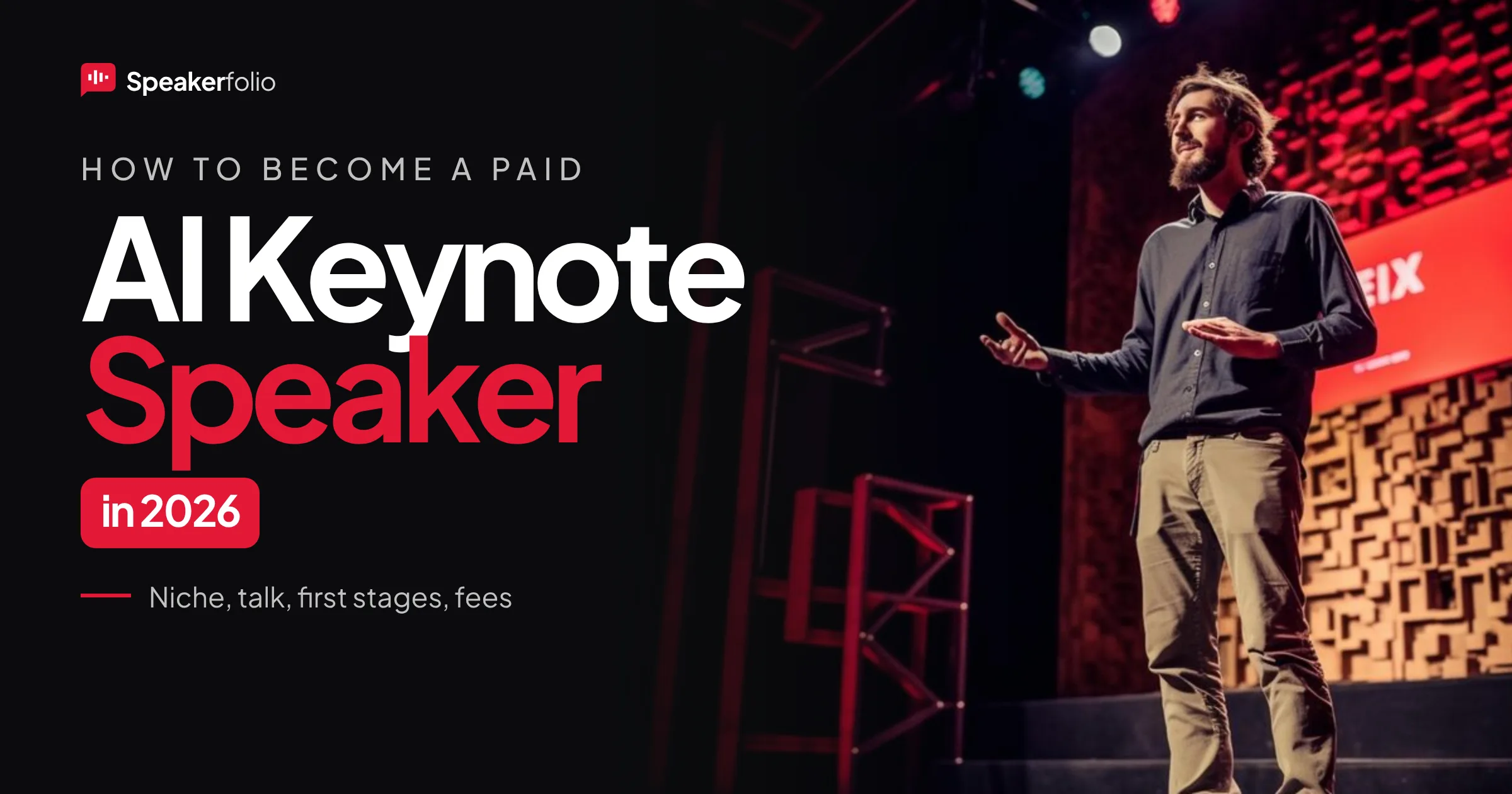
To become a paid AI keynote speaker in 2026, pick a specific AI niche you can speak about from real experience (such as AI for hospitals, AI in sales teams or AI policy for small businesses), build one practical signature talk with a safe demo, get your first stages through associations, meetups and company events, film yourself, then put your talk, reel and proof on a speaker website before you start charging. Demand is strong: AI was the top trending topic in one major bureau's 2026 client survey, and bureau-listed AI experts commonly charge $15,000 or more per keynote. Most new speakers start far lower, so this guide covers the full path, from your first free talk to your first paid booking and beyond.
Key takeaways
- Event planners want AI talks, but not generic ones. "AI for [your industry or role]" beats "The future of AI."
- Practitioner proof wins. Projects you've shipped and results you've seen matter more than certificates.
- Your talk needs updating more often than most. Plan to refresh examples every few months.
- Get paid in steps. Free talks build proof, then smaller paid talks, then higher fees as reviews and video stack up.
Why AI keynote speakers are in demand in 2026
AI is the topic event planners ask for most right now. Two recent data points from speaker bureaus show it:
- Speakers Spotlight asked its clients which topics were most relevant to their audiences in 2026. AI and emerging technology came first, chosen by 67% of respondents, ahead of leadership and change management at 50%, according to the bureau's 2026 survey summary.
- BigSpeak's list of its most-booked meeting topics for the third quarter of 2026 put artificial intelligence at number one, noting that "AI continues to top booking charts."
Why? Almost every organisation is trying to work out what AI means for its people, customers and costs. Conferences want someone who can explain it clearly. Companies want someone to calm fears, spark ideas and show teams how to use AI well. Associations want sessions that help members in their specific field.
That's the opportunity. The challenge is that many people now call themselves AI speakers. To get paid, you need to stand out with a clear niche, real experience and a talk that leaves audiences with something useful.
How much do AI keynote speakers earn?
Here's what published 2026 fee guides say. Keep in mind these figures come from speaker bureaus and speakers who sell keynotes, so they describe the established end of the market.
| Level | Published 2026 range | Source |
|---|---|---|
| General entry-level keynotes | About $5,000 | Speakers.com fee schedule, cited by Speak About AI |
| Emerging speakers (all topics) | Under $10,000 | Bureau pricing guides, cited by Mark Lynd |
| Emerging AI experts on a bureau roster | $15,000 – $20,000 | Speak About AI roster ranges |
| Established AI founders and researchers | $20,000 – $30,000 | Speak About AI roster ranges |
| Marquee AI names | $30,000 – $65,000+ | Speak About AI roster ranges |
| Virtual AI keynotes | 50% – 75% of the in-person rate | Speak About AI |
A few things to note:
- AI carries a premium. Speak About AI puts entry-level AI expertise at about $15,000, compared with about $5,000 for general entry-level keynotes. A speaker-written guide by Mark Lynd also says AI sits at the expensive end of each tier.
- Bureau rosters aren't the starting line. Speakers listed with a bureau already have proof, video and demand. If you're new, your first paid talks will usually be well below these ranges, often with smaller associations, regional conferences or company events.
- Extras add up. Customisation, recording rights, workshops and travel are often priced on top of the keynote fee.
The rest of this guide is about getting from where you are now to the point where those numbers are realistic for you.
Step 1: Pick an AI niche you can own
"AI keynote speaker" is too broad. Event planners book speakers who match their audience. The fastest way to get booked is to be the obvious choice for a specific group.
A strong AI niche usually combines AI + an industry or role + a problem:
| Broad (hard to sell) | Niche (easier to sell) |
|---|---|
| The future of AI | AI for hospital operations: what's working now |
| AI and leadership | How managers lead teams that use AI every day |
| AI in business | AI for small accounting firms: save 10 hours a week without new risks |
| AI and creativity | AI for marketing teams: faster campaigns without losing your brand voice |
| AI ethics | AI policy for school districts: a practical starting point |
| AI and jobs | Reskilling frontline workers for AI: what HR teams can do this year |
To find yours, ask:
- Where do I have real experience? An industry you've worked in, a role you've held, a project you've led.
- Who already asks me about AI? Colleagues, clients, your professional network.
- Which events serve that audience? Associations, trade shows, regional conferences, company kickoffs.
- What do they worry about? Jobs, cost, risk, quality, falling behind competitors.
You can widen your topic later. Starting narrow gets you your first bookings faster, because you're competing with a handful of people instead of thousands.
Step 2: Build credibility that event planners trust
Planners want an AI speaker who has actually done something with AI, not just read about it. Credibility for AI speakers usually comes from:
- Hands-on work: AI projects you've led or built, tools you've rolled out, results you can describe.
- Industry experience: years in the field your audience works in.
- Original thinking: articles, a newsletter, a podcast or LinkedIn posts that show how you think.
- Teaching: workshops, courses or internal training you've delivered.
- Recognition: media quotes, awards, advisory roles or a book.
| Strong proof | Weak proof |
|---|---|
| "Led the rollout of an AI scheduling tool across 12 clinics" | "Passionate about AI" |
| "Trained 300 marketers to use AI in their daily work" | "AI enthusiast and thought leader" |
| "Writes a weekly newsletter on AI for finance teams" | "Completed several online AI courses" |
Certificates can help, but they're rarely the reason a planner books you. Real examples are.
Be honest about what you know. AI changes quickly, and audiences include people who know more than you about some parts of it. Say "here's what I've seen work" rather than claiming to predict the future. That honesty builds trust and protects your reputation.
Step 3: Create a signature AI keynote
Your signature talk is the product you sell. For AI, the best talks share a few traits:
- Practical, not hype. Audiences are tired of "AI will change everything." They want to know what to do on Monday.
- Specific to the audience. Examples from their industry, their roles, their tools.
- Balanced. Honest about risks and limits, as well as the opportunities.
- Memorable. One clear idea, a simple framework and a few strong stories.
A simple structure for an AI keynote
| Part | What it does | Time (45-minute keynote) |
|---|---|---|
| Opening hook | A surprising demo, story or question about AI in their world | 3–5 minutes |
| The shift | What's changing in their industry, in plain words | 5–8 minutes |
| Your framework | 3–5 steps or principles for using AI well | 15–20 minutes |
| Demo or case study | Show it working, ideally with an example from their field | 5–10 minutes |
| Risks and guardrails | What to watch out for, and how to stay safe | 3–5 minutes |
| Call to action | One thing to try this week | 2–3 minutes |
If you have a method or framework, give it a name and present it clearly. Our guide on how to present a leadership framework on one page works just as well for an AI framework.
Write talk titles planners can sell
Planners have to pitch your talk to their committee and their audience. Titles that name the audience and the outcome are easier to sell:
- "AI for Busy Managers: Five Ways to Save a Day a Week, Safely"
- "The AI-Ready Hospital: What Frontline Teams Need to Know Now"
- "Beyond the Hype: A Practical AI Plan for Small Businesses"
For more on making any talk land, see the secrets of great public speakers, from strong openings to the pause.
Step 4: Plan your demos carefully
Live demos are powerful in an AI talk. They can also go wrong in front of hundreds of people. Plan for that.
- Have a recorded backup of every demo, ready to play if the live version fails.
- Don't rely on venue Wi-Fi. Use a mobile hotspot or pre-recorded clips.
- Avoid sharing private or client data on screen. Use made-up examples.
- Rehearse the exact prompts you'll use, and know what the tool usually does.
- Keep demos short. Two or three minutes each is plenty.
- Explain what's happening. The audience may not follow the screen as quickly as you.
If a demo fails, say so with a smile and switch to the backup. Audiences forgive technology problems far more easily than a speaker who panics.
Step 5: Keep your talk up to date
AI moves faster than almost any other topic. Examples that impressed people six months ago can feel stale now. Build updates into your routine:
- Review your talk every few months. Replace outdated tools, numbers and examples.
- Keep a "fresh examples" file. Save interesting news, cases and demos as you see them.
- Tailor examples for each event. Ask the organiser about their audience and recent challenges.
- Date-stamp your slides privately. Know when each example was last checked.
- Avoid predictions with dates. They age badly. Focus on principles and practices.
This is also a selling point. Tell planners your talk is updated for every event. It shows you care about accuracy.
Step 6: Get your first stages
You need experience and video before most organisers will pay you. The good news is that AI is in such demand that many groups are happy to host a well-prepared speaker.
| Where to start | Why it works |
|---|---|
| Local meetups and tech groups | Easy to book, friendly audiences, good practice |
| Professional associations in your niche | They need AI sessions for members, and lead to paid events |
| Chambers of commerce and business groups | Small business owners want practical AI advice |
| Your own employer or past employers | Internal events, lunch-and-learns, leadership offsites |
| Webinars and virtual summits | Low pressure, recordable, wide reach |
| Podcasts | Build reputation and give planners something to listen to |
| Universities and colleges | Guest lectures and events, often filmed |
| Local conferences and trade shows | Panels and breakout sessions lead to keynotes |
Aim for five to ten talks in your niche in your first few months. After each one:
- Ask for a testimonial from the organiser, with their name and role. Our guide on how to ask for testimonials shows what to send.
- Ask for video or record it yourself.
- Ask who else should hear the talk. Organisers often know other organisers.
Step 7: Film yourself and build a speaker reel
Planners booking an AI speaker want to see two things: that you understand the subject, and that you can hold a room. Video shows both.
- Record every talk you can, even with a phone on a tripod at the back of the room.
- Capture audience reactions: laughter, nodding, people taking photos of your slides.
- Make a two- to three-minute reel with your best moments, including a short demo clip.
- Keep a full-length talk available for planners who want to see more.
Our guide on how to make a speaker reel from footage you already have walks through the process.
Step 8: Build your speaker website and one-sheet
When a planner hears your name, the first thing they do is look you up. Your speaker website is where they decide whether to contact you. For an AI speaker, it should include:
- A clear headline with your niche: "AI keynote speaker for healthcare leaders"
- Your signature talks with titles, formats and takeaways
- Your speaker reel, near the top
- Proof: client names, testimonials, results and media
- Your experience with AI: projects, roles and writing
- Formats: keynote, workshop, panel, virtual
- A booking form with a quick reply promise
Our keynote speaker website examples show eight layouts that get speakers booked, from a stage-photo hero to a reel-first page.
Add a one-page summary planners can forward to their committee. Our guide on how to create a speaker one-sheet includes a free template.
Step 9: Set your fees and start charging
Many new speakers stay unpaid too long. Others charge bureau-level fees before they have the proof to back it up. A step-by-step approach works better.
| Stage | What you have | What to do about fees |
|---|---|---|
| Building | A talk, a few practice events | Speak free for groups that give you video, testimonials or access to your target audience |
| First paid | 5–10 talks, a reel, a few testimonials | Charge a modest fee for smaller events; always ask for travel to be covered |
| Growing | Regular bookings, strong reviews, a clear niche | Raise your fee with every few bookings; add workshops and packages |
| Established | Steady demand, larger clients, media | Fees closer to published AI ranges; bureaus may take interest |
Some practical rules:
- Always charge for corporate events. Companies have budgets. Free talks are for building proof, usually with community groups and associations.
- Set a fee range, not a single number. For example, a lower fee for nonprofits and a standard fee for corporate events.
- Price virtual talks lower than in-person, but not by much. Published guides put virtual AI keynotes at 50% to 75% of in-person fees.
- Add workshops. Many AI keynote speakers earn more from the hands-on workshop after the keynote than from the keynote itself.
- Raise your fee when you're consistently booked. If every enquiry says yes immediately, your fee is too low.
If you also run AI training for companies, our guide to corporate trainer fees covers day and half-day rates.
Step 10: Find paid AI speaking gigs
Once you have a talk, a reel and a website, go looking for paid work.
- Industry associations. Many have annual conferences and need AI sessions. Contact their education or events team.
- Corporate events. Sales kickoffs, leadership offsites and all-hands meetings increasingly include an AI session.
- Conference calls for speakers. Search for events in your niche and apply early.
- Your network. Tell people you speak on AI. Many first paid bookings come from someone who heard you once.
- Event planners and agencies that organise corporate events.
- Speaker directories where planners search by topic.
- Speaker bureaus, once you have strong video, proof and demand. Bureaus usually approach established speakers or accept applications from speakers who already get booked.
A short outreach email you can adapt
Subject: AI session for your [event name] members
Hi Dana,
I saw that the Midwest Clinic Managers Association is holding its spring conference in April. I speak on practical AI for clinic operations: how teams are using it today for scheduling, notes and patient messages, and what to watch out for.
My keynote, "The AI-Ready Clinic," gives managers five things they can try the following week. Here's a two-minute clip and my speaker page: [link].
Would an AI session fit your programme this year? Happy to tailor it to your members.
Best, Marcus Hale
Keep it short, specific to their audience, and link to your website so they can see you speak.
Ethics and credibility: protect your reputation
AI speakers face a credibility test that other speakers don't. A single exaggerated claim can spread quickly. Keep these habits:
- Check facts and cite sources for any numbers you share.
- Disclose relationships with AI companies or tools you mention.
- Be balanced about risks: bias, privacy, accuracy, security and jobs.
- Don't promise results you can't control.
- Respect privacy in demos and examples.
- Admit uncertainty. "We don't know yet" is a credible answer.
Planners want speakers who make their event look good. A speaker known for clear, honest, practical AI talks gets rebooked and referred.
A 90-day plan to become a paid AI keynote speaker
| Weeks | Focus | Actions |
|---|---|---|
| 1–2 | Niche and positioning | Pick your niche; write your one-line promise; list target events |
| 3–4 | Signature talk | Outline your talk and framework; build demos and backups |
| 5–6 | First stages | Book 2–3 free or low-cost talks with meetups, associations or your network |
| 7–8 | Proof | Deliver talks; collect testimonials and video |
| 9–10 | Website and reel | Build your speaker website and reel; create a one-sheet |
| 11–12 | First paid outreach | Contact associations and companies; quote your first fee |
Some people get paid within three months. Others take longer, depending on their niche, network and experience. What matters is that each talk produces something: video, a testimonial, a referral or a lesson.
Common mistakes new AI keynote speakers make
- Being too broad. "AI for everyone" is AI for no one in particular.
- Hype over substance. Audiences want practical steps, not just big predictions.
- No real experience. Repeating headlines isn't enough; share what you've seen work.
- Outdated examples. A talk built a year ago may already feel old.
- Risky live demos with no backup.
- No video. Without it, planners can't judge you.
- Charging too early or too late. Build proof first, then charge steadily more.
- A weak website. If planners can't quickly see your talks, reel and proof, they move on.
How Speakerfolio helps AI keynote speakers get booked
Speakerfolio builds speakers a professional website and lists them where planners search, so you can focus on your talk.
- Free speaker website: written and built for you from your LinkedIn profile, on yourname.speakerfolio.com, usually within two working days. It includes your AI talks, reel, testimonials, experience and a booking form.
- A profile in the Speakerfolio speaker directory, where event planners search by topic, including technology and AI.
- No commission: booking requests go straight to you.
- Premium ($100 a year): a custom design on your own domain, with as many pages as you need, such as a page for each talk or workshop.
Browse our speaker website templates to see the layouts.
Frequently asked questions
How do I become a paid AI keynote speaker?
Pick a specific AI niche you know from experience, create a practical signature talk, get your first stages through meetups, associations and company events, collect video and testimonials, build a speaker website, then start charging modest fees and raise them as demand grows.
How much do AI keynote speakers get paid in 2026?
Published 2026 guides put emerging AI experts on bureau rosters at about $15,000 to $20,000 per keynote, established experts at $20,000 to $30,000 and marquee names at $30,000 to $65,000 or more. New speakers usually start much lower.
Do I need to be a technical expert to be an AI keynote speaker?
Not always. You need real experience with how AI is used in your audience's world. A healthcare manager who led an AI rollout can be more valuable to a hospital audience than a researcher with no frontline experience.
What are the best AI keynote topics in 2026?
Practical, audience-specific topics do best: AI for a particular industry or role, leading teams that use AI, AI risks and guardrails, reskilling and the future of work, and AI strategy for small businesses.
How do I get my first paid AI speaking gig?
Start with free or low-cost talks to build video and testimonials, then approach associations, companies and conferences in your niche with a short, specific pitch and a link to your speaker website.
Should I use live demos in an AI keynote?
Yes, if you prepare well. Keep them short, use your own hotspot, avoid private data, and always have a recorded backup.
How often should I update an AI keynote?
Review it every few months and tailor examples for every event. AI tools and news change quickly, and outdated examples hurt credibility.
Do speaker bureaus represent new AI speakers?
Bureaus usually work with speakers who already have strong video, proof and demand. Build those first, then approach bureaus or let them find you.
Start with one niche and one talk
Becoming a paid AI keynote speaker in 2026 isn't about knowing everything about AI. It's about knowing one audience well and helping them use AI wisely. Pick your niche, build a practical talk with safe demos, get on stage, film it, and show it all on a clear speaker website. Then charge, and keep raising your fee as the proof grows. When you're ready, get your free speaker website from Speakerfolio.
Sources: Speakers Spotlight, Survey Says: Trending Topics in 2026; BigSpeak, Most-Booked Meeting Topics; Speak About AI, How Much Does an AI Keynote Speaker Cost in 2026?; Mark Lynd, How Much Does an AI Keynote Speaker Cost in 2026?. Figures checked on 24 November 2026.

Saleh is a UI/UX and web designer with more than five years of experience and the founder of Speakerfolio, where he builds websites that help speakers get booked. He specialises in conversion-focused design and on-page SEO.
Connect on LinkedInRelated articles
All articles